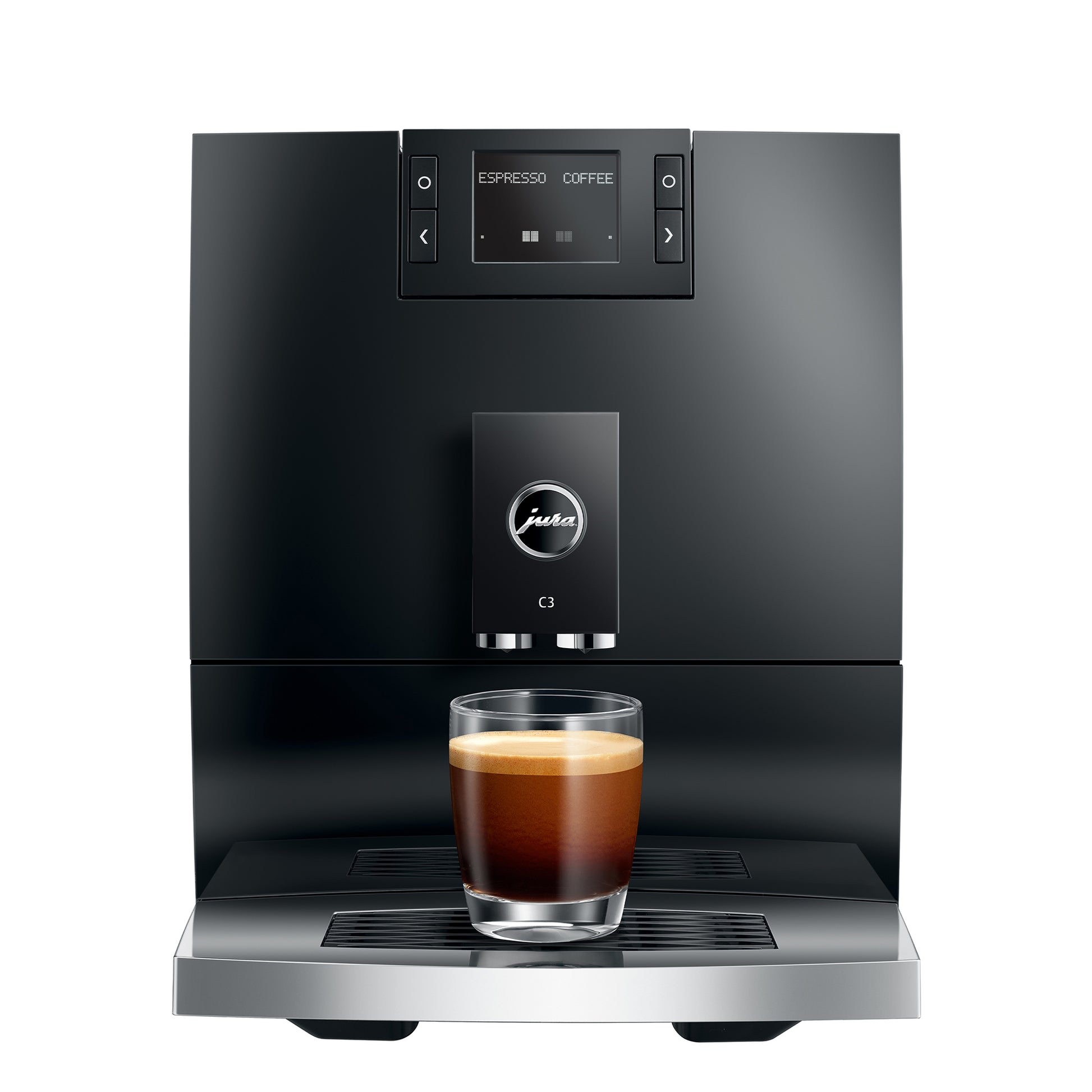
Quick Answer: The Jura C3 is a $1,199 super-automatic that makes only two things - espresso and coffee - with no milk system at all. Launched April 2026, it’s positioned as the machine that replaces the ENA 4 in Jura’s lineup, but it is not a budget option: at $1,199 it costs $300-500 more than the ENA 4 while doing considerably less. It exists for a narrow buyer - someone who wants Jura’s current-generation full-size brew group and Pulse Extraction Process in the smallest possible footprint, and genuinely never drinks milk-based coffee.
What Is the Jura C3?
The C3 is the entry point into Jura’s new compact C-Series, launched April 2026 alongside the C9 (the premium compact model that replaces the ENA 8). Where the C9 adds an integrated milk system and 17 specialties, the C3 strips everything back to black coffee only.
Confirmed specs:
- $1,199 (Piano Black or Piano White)
- 2 drink options: espresso and coffee only - no milk-based drinks
- Full-size 5-16g brew group with Pulse Extraction Process (P.E.P.)
- 7 oz bean hopper, 54 oz water tank
- LED display with color-coded menu system, physical tactile buttons
- Built-in conical steel burr grinder, adjustable strength and temperature
- Accepts pre-ground coffee via an included funnel (in addition to whole bean)
- Most compact footprint in the current Jura lineup: 10.2” W x 12.8” H x 17.2” D
- 19.4 lbs
The C3 vs the ENA 4: More Money, Fewer Drinks
This is the comparison most buyers will actually make, since the C3 is positioned as the ENA 4’s successor:
| Feature | Jura C3 | Jura ENA 4 |
|---|---|---|
| Price | $1,199 | $700-$900 |
| Drink options | 2 (espresso, coffee) | 8 |
| Milk system | None | Optional HP1 add-on |
| Brew group | Full-size 5-16g | Standard |
| Display | LED, color-coded | Text |
| Footprint | 10.2” x 12.8” x 17.2” | 4.4” wide (narrowest) |
The C3 is a genuinely confusing value proposition on paper: it costs more than the ENA 4 while offering fewer drinks and no milk option. Its case rests entirely on two things the spec sheet doesn’t capture well - the full-size 5-16g brew group (a step up from typical entry-tier brew groups) and current-generation P.E.P. extraction, both of which matter if espresso quality is your only priority and you have zero interest in milk drinks.
Recommended Entry Pick
Jura ENA 4 - More Drinks, Lower Price
$700-$900, 8 specialties, optional milk add-on, narrowest Jura footprint at 4.4”. For most buyers this beats the C3 on price and flexibility.
Who Should Actually Buy the C3
- Coffee purists who never drink milk-based drinks and want Jura’s current-generation grinder and extraction technology without paying for milk hardware they’d never use.
- Buyers who value the pre-ground funnel option - useful for switching to decaf occasionally without a second bean hopper.
- Anyone comparing it to the ENA 4 purely on drink count or price should buy the ENA 4 instead - it’s cheaper and more capable for the vast majority of households.
The C3’s Real Competitor Is the C9, Not the ENA 4
Despite officially “replacing” the ENA 4 in Jura’s lineup, the C3’s price puts it much closer to entry-E-series territory than true budget territory. If milk drinks matter at all - even occasionally - the Jura C9 at $1,799 adds a full integrated milk system and 17 specialties for $600 more, which is a better value proposition than the C3’s $1,199 for coffee-only. The C3 only wins if you are certain you’ll never want milk drinks from this machine.
If Milk Drinks Are Even a Maybe
Jura C9 - Adds Milk for $600 More
$1,799, 17 specialties, integrated milk system, Light Extraction Process. If there’s any chance you’ll want a cappuccino someday, this is the better $1,199-and-up option.
Check C9 Price →Espresso Quality: What the Spec Sheet Actually Tells You
Jura hasn’t published independent third-party lab testing for the C3 yet, so treat cup-quality claims with appropriate caution until hands-on reviews accumulate. What the confirmed specs do tell you:
The full-size 5-16g brew group is the C3’s headline feature relative to typical entry-tier machines. A larger dose range means more headroom for both a concentrated ristretto-style pull and a longer lungo without the grounds bed becoming too thin or too dense - the same brew group Jura uses across its current-generation lineup, not a scaled-down entry version. Paired with Pulse Extraction Process (P.E.P.), which pulses water through the puck in short bursts rather than a single continuous flow, this should produce meaningfully better extraction consistency on straight espresso than older basic-tier Jura machines that lack P.E.P. entirely.
The conical steel burr grinder with adjustable fineness is standard Jura hardware, not a stripped-down unit - you get the same dial-in flexibility (grind size, strength, temperature, per-drink presets) that the ENA 4 and E8 offer, just without milk-related settings to configure.
What this means in practice: if espresso and drip-style coffee are genuinely all you drink, the C3’s hardware suggests it should out-perform older basic Jura models and hold its own against similarly-priced semi-automatic machines on convenience, if not on manual control. The honest caveat: with no milk system and only 2 drink modes, you are paying E-series money for a machine with S-series-adjacent hardware but a fraction of the versatility.
Daily Workflow
Based on Jura’s standard interaction model (carried over from the rest of the C-Series and E-Series), expect: press a button, the machine grinds fresh beans, tamps, and pulls the shot automatically, with the LED display walking you through strength/temperature adjustments via physical buttons rather than a touchscreen. The color-coded LED display is simpler than the E8’s or S8’s screens, but for a 2-drink machine there’s little need for deeper menu navigation - most of the interface complexity in Jura’s pricier models exists to manage milk settings the C3 doesn’t have.
Bean-hopper capacity (7 oz) and water tank (54 oz) are both in line with Jura’s compact-class machines generally, meaning refill frequency should be comparable to the ENA 4 rather than needing more frequent attention.
Pros and Tradeoffs
What it does well:
- Full-size 5-16g brew group and P.E.P. extraction bring current-generation Jura hardware to the entry tier for the first time
- Genuinely simple to operate - two drinks, no milk system to configure or clean
- Accepts pre-ground coffee via the included funnel for occasional decaf switching
- Most compact footprint in Jura’s current US lineup
Where it falls short:
- $1,199 is a difficult price to justify next to the ENA 4’s $700-900 for 4x the drink options
- Zero milk capability means it’s a non-starter for any household that drinks cappuccino, latte, or flat white even occasionally
- New enough (April 2026) that independent long-term reliability data doesn’t exist yet
- The C9 at $600 more is arguably the better buy for most people weighing “C-Series or bust,” since it adds milk capability the C3 permanently lacks
Maintenance
The C3 uses Jura’s standard CLARIS water filter system and the same cleaning tablets as every current Jura model. Maintenance is unchanged from the rest of the lineup: weekly cleaning tablet cycle, descaling every 2-3 months depending on water hardness, and regular brew unit rinsing. Since there’s no milk system, the C3 skips the milk-circuit rinse step that adds a small amount of daily maintenance to Jura’s milk-capable models - one of the few places where the stripped-down feature set is a genuine convenience, not just an omission.
FAQ
Does the Jura C3 make milk drinks?
No. The C3 has no milk system at all - it makes only espresso and coffee. If you want cappuccino, latte, or flat white, look at the ENA 4 with the optional HP1 milk add-on, or step up to the E8.
Is the Jura C3 cheaper than the ENA 4?
No - the C3 is $1,199, more expensive than the ENA 4 (typically $700-$900), despite offering fewer drinks (2 vs 8) and no milk system. It’s not a budget replacement for the ENA 4 on price; it targets buyers who specifically want a coffee-only machine with Jura’s full-size 5-16g brew group.
Can the Jura C3 use pre-ground coffee, or only whole beans?
Both. The C3 ships with a funnel that lets you bypass the grinder and brew with pre-ground coffee for a single cup - useful for switching to decaf occasionally without needing a second bean hopper. Whole-bean grinding through the built-in conical burr grinder is the default and recommended mode for daily use.
What is the difference between the Jura C3 and Jura C9?
The C3 is coffee-only (espresso and coffee, no milk system) at $1,199. The C9 adds a full integrated milk system, 17 specialties, and Jura’s new Light Extraction Process at $1,799. If there is any chance you will want milk-based drinks, the C9’s extra $600 buys meaningfully more machine. The C3 only makes sense if you are certain you will never want a cappuccino from it.
Does the Jura C3 have adjustable grind size?
Yes. The built-in conical steel burr grinder has adjustable fineness, along with adjustable strength and temperature settings per drink. This is standard across Jura’s current lineup, including the entry-tier C3.
Final Verdict
The C3 is a coherent product on its own terms - a genuinely simple, current-generation espresso-and-coffee machine for someone who has already decided milk drinks aren’t part of their routine. Where it struggles is Jura’s own lineup context: at $1,199 it sits close enough to the C9 ($1,799) that the extra spend for full milk capability looks like the smarter buy for most undecided shoppers, and far enough above the ENA 4 ($700-900) that “budget ENA 4 replacement” undersells what it actually costs.
Buy the C3 if: you are certain milk drinks aren’t happening on this machine, ever, and you specifically want Jura’s current-generation brew group and P.E.P. extraction in the smallest footprint available.
Buy the ENA 4 instead if: price matters, you want the optional milk add-on flexibility, or you’re not fully certain you’ll never want a cappuccino.
Buy the C9 instead if: the extra $600 is realistic for your budget and there’s any chance milk drinks matter to you.
Coffee-Only, Compact
Jura C3
$1,199. Full-size brew group, P.E.P. extraction, no milk system.
Check Price →Better Value Entry Pick
Jura ENA 4
$700-$900. 8 specialties, optional milk add-on, cheaper than the C3.
Check Price →If Milk Might Matter
Jura C9
$1,799. Adds a full integrated milk system for $600 more.
Check Price →As an Amazon Associate, we earn from qualifying purchases at no extra cost to you.