A Jura E8 and a Lelit Bianca V3 are both serious espresso money, and both are aimed at someone who cares about their coffee. That is roughly where the resemblance ends. The Bianca V3 hands you a lever, three pressure gauges, and independently adjustable temperatures for both boilers, and expects you to use them. The E8 hides every one of those variables behind a button and makes the same decision every time so you never have to.
Other pages on this site already cover what a manual dual-boiler costs you in time and in dollars against an E8. This one asks a different question: once you have the Bianca V3’s controls in front of you, what can you actually change, what does changing it do, and does that control make your coffee better - or just make your mornings longer?
The Zero-Adjustment Side of This Comparison
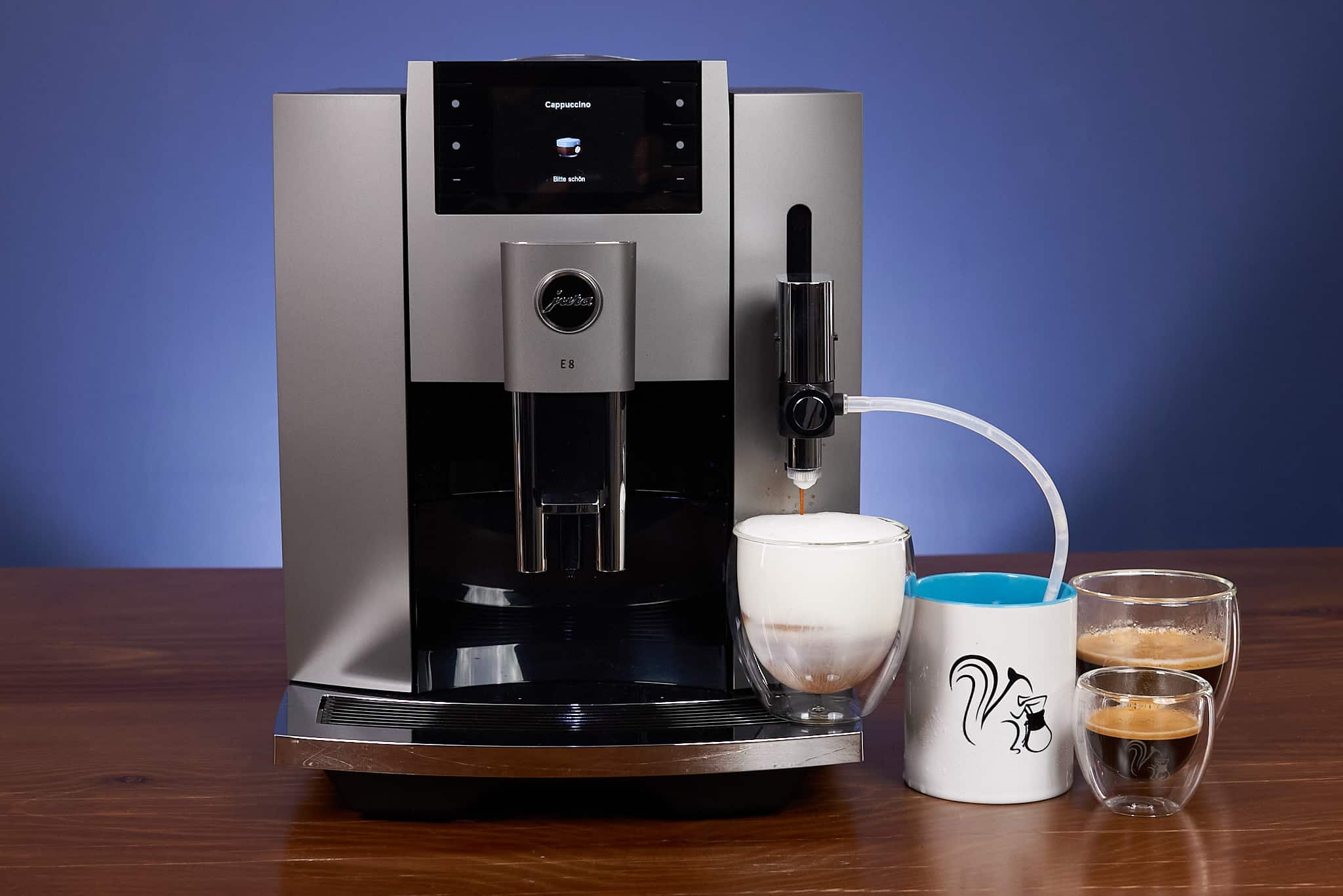
Jura E8 - One Button, the Same Great Shot Every Time
27 one-touch specialties in the current 5th-gen model, built-in grinder, HP3 milk system. Nothing to dial in, nothing to get wrong.
Quick Answer
Buy the Lelit Bianca V3 if you want to shape every shot yourself: a flow-profiling paddle, independent brew and steam PID, and a commercial E61 group give you more real control than any super-automatic offers, for roughly $2,999 plus a separate grinder. Buy the Jura E8 if you want excellent, identical espresso and milk drinks with zero adjustment and zero learning curve, for roughly $1,399-$1,599 all-in. The deciding question is not which machine is “better” - it’s whether you actually plan to use the controls the Bianca V3 puts in front of you.
Who Each Machine Is For
The Lelit Bianca V3 is an Italian-built prosumer dual-boiler designed around one idea: nothing about the shot should be fixed by the manufacturer that the owner might want to change. A 0.8-liter brass-and-steel brew boiler and a separate 1.5-liter steam boiler each run their own PID loop, adjustable independently in single-degree steps from an OLED display. The saturated E61 group head carries Lelit’s patented rotating flow-control paddle - a lever that opens or closes a needle valve controlling water flow in real time, while the shot is running. Three external gauges show brew pressure, steam pressure, and group pressure at a glance. Nothing is automated: you bring your own grinder, dose and tamp by hand, and decide, shot by shot, how the water moves through the puck.
The Jura E8 is a Swiss super-automatic built around the opposite idea: the owner should never have to make an extraction decision. Press a button and the machine grinds fresh beans on its built-in Professional Aroma Grinder, brews with Jura’s fixed Pulse Extraction Process, and - for milk drinks - draws and froths milk through the HP3 system in the same sequence. The current 5th-generation model runs 27 specialties one-touch. Our full Jura E8 review covers it in depth.
Both machines assume you are done experimenting with entry-level equipment and are ready to spend real money on daily espresso. They just disagree, completely, about who should be making the extraction decisions - you, or the machine.
Spec Table: Sourced, Side by Side
Prices are approximate street prices at the time of checking and move often - use the price links for current figures. Every figure below is sourced at the end of this article.
| Spec | Jura E8 | Lelit Bianca V3 |
|---|---|---|
| Type | Super-automatic (bean to cup) | Semi-automatic prosumer dual-boiler with flow control |
| Approx. machine price | ~$1,399-$1,599 | ~$2,999 |
| Grinder | Built in (Professional Aroma Grinder, P.A.G.2) | None - separate grinder required |
| Heating | Thermoblock, single, fixed | Dual boiler: 0.8 L brew (1000 W) + 1.5 L steam (1400 W) |
| Temperature control | Fixed per specialty, adjustable only in preset steps | Dual PID, independently adjustable brew and steam, single-degree steps, OLED display |
| Brew group | Internal, automatic dosing and tamping | E61 saturated group, commercial 58 mm, bottomless and double-spouted portafilters included |
| Flow and pressure control | None - fixed extraction profile | Rotating flow-control paddle (0 to ~6-7 ml/s, adjustable mid-shot); adjustable OPV, factory set to 11 bar |
| Pre-infusion | Not user-adjustable | Manual via paddle, or programmable low-flow start/end (V3 automates paddle movement) |
| Milk | HP3 one-touch milk system | Manual steam wand, dedicated 1.5 L steam boiler, cool-touch design |
| Pump | Vibration pump (fixed) | Rotary vane pump |
| Heat-up | Under a minute, on demand | Approx. 20-24 minutes to full dual-boiler readiness |
| Water tank | 1.9 L (64 oz) | 2.5 L, repositionable, direct plumb-in supported |
| Dimensions (W x H x D) | 11 x 13.8 x 17.6 in | 11.4 x 15.75 x 19.1 in |
| Weight | 22.1 lb (10 kg) | 58.5 lb |
| Power | 1450 W (120 V) | 1400 W max (120 V, 15-amp plug) |
The pattern in that table is not really “more expensive machine, more features.” It is that almost every row where the Bianca V3 adds a spec, the E8’s answer is “not applicable” - not because Jura’s engineers couldn’t build in a flow paddle, but because the E8’s entire design brief is to never hand you one.
What You Can Actually Change: A Real Comparison
This is the part spec tables gloss over. Here is every meaningful shot-level variable on each machine, and who controls it.
| Variable | Jura E8 | Lelit Bianca V3 |
|---|---|---|
| Grind size | A small number of preset steps on the internal P.A.G.2 grinder | Fully user-controlled - whatever your separate grinder offers, often 30-50+ micro-steps |
| Dose weight | Machine-set per specialty, not user-editable by weight | Fully user-controlled - weigh in your own dose to the tenth of a gram |
| Tamp pressure and levelness | Automatic, internal, not adjustable | Fully manual - your tamp, your consistency |
| Brew temperature | Preset per specialty, a few coarse steps | PID-set to the degree, independent of steam boiler |
| Pre-infusion | Not exposed - built into the fixed Pulse Extraction Process | Manual, via the paddle, or programmable low-flow at shot start |
| Flow rate during the shot | Not exposed | Live, via the paddle - speed up or slow down mid-extraction |
| Brew pressure ceiling | Fixed by design | Set by the OPV (factory 11 bar, internally adjustable - Lelit advises against changing it) |
| Shot volume / stop point | Preset by specialty, adjustable in the app-free menu | Manual by eye, weight, or the built-in flow meter’s volumetric dosing |
| Milk texture | Fixed by the HP3 program per drink | Fully manual on a cool-touch wand fed by its own boiler |
Read down the E8 column and the pattern is total: every row says “preset,” “fixed,” or “automatic.” Read down the Bianca V3 column and every row says “yours.” That is not a criticism of either machine - it is the entire reason each one exists.
A Worked Scenario: Dialing In a Light-Roast Single Origin
Specs are abstract. Here is what that difference looks like with an actual bag of coffee, reasoned from each machine’s confirmed hardware, not from hands-on testing of the Bianca V3.
Say you buy a light-roast Ethiopian single origin - dense, low in solubility, the kind of bean that chokes if you extract it like a dark-roast blend. On the Bianca V3, the recommended approach for a bean like this starts with a finer grind and a longer, gentler pre-infusion than a typical medium roast needs, because light-roast cell structure resists water and benefits from being saturated slowly before full pressure hits. With the paddle, you would rotate it to a low-flow position at the start of the shot, hold the puck under gentle pressure for several seconds longer than usual, then open the paddle to build toward full flow once the puck is saturated - watching the group pressure gauge and adjusting in real time if the shot is running fast or choking. If the first attempt tastes sour and under-extracted, the fix is available on the same machine: grind finer, extend the pre-infusion further, or slow the paddle more before opening it. Each adjustment is a variable you already have in hand.
On the E8, none of that is available. The machine’s Pulse Extraction Process is one fixed sequence regardless of bean - a very good sequence, engineered by Jura to work well across most beans, but not one that treats light-roast Ethiopian differently from a Brazilian dark roast except through the strength, volume, and temperature presets exposed on the display. If a shot tastes sour on the E8, your adjustment options are the coarse grind steps, the strength setting, and the brew temperature step - not pre-infusion length, not flow shaping, not pressure. You can move the shot in the right general direction. You cannot fine-tune it the way the Bianca V3 lets you.
This is the whole comparison in one bag of beans: the Bianca V3 gives you a real answer to “this specific coffee needs something different,” and the E8 gives you a good-enough answer to every coffee, the same way, every time.
Does More Control Actually Help You?
Here is the honest part of this page. A flow paddle, an adjustable OPV, and independent PID temperatures are only valuable to the extent you use them - and using them well takes a skill floor the E8 was built specifically to remove.
To get more out of the Bianca V3 than the E8 already gives you for free, you need a few things in place first: a grinder capable of the fine, consistent grind adjustment espresso demands (the Bianca V3 does not include one, and a mismatched grinder undercuts everything else on this list); a reasonably consistent dose and tamp, since the paddle cannot fix an uneven puck; and, most of all, the ability to taste a shot and diagnose what went wrong - sour means under-extracted, bitter means over-extracted, thin means channeling - and translate that diagnosis into a specific paddle or temperature change. None of that arrives with the machine. It is built over weeks of pulling shots, adjusting, and pulling more.
Skip that groundwork and the Bianca V3’s extra controls do not sit idle - they become extra ways to get a worse shot than before. A paddle opened too early floods the puck and channels water around it. A pre-infusion held too long over-extracts a delicate bean. An OPV nudged down “to see what happens” can, per Lelit’s own guidance, run the brew boiler’s heating element dry. The E8 cannot make any of those mistakes, because none of those decisions are on the table. Its ceiling is lower than a well-run Bianca V3’s, but its floor is far higher than a poorly-run one’s.
So the real question this page exists to ask is not “which machine has more control,” because the spec table already answered that. It is: do you have, or want to build, the palate and the routine to spend that control well? If yes, the Bianca V3 rewards you in a way no super-automatic can. If the honest answer is “probably not, at least not for a while,” the E8’s fixed process is not a limitation - it is a shortcut to the result the Bianca V3 makes you earn.
If the Answer Was “Probably Not”
The E8 Skips the Learning Curve Entirely
Every shot engineered by Jura, delivered identically, with nothing for you to diagnose or adjust.
Milk Workflow
The milk side of this comparison follows the same control-vs-consistency shape as the espresso side.
Lelit Bianca V3: a dedicated 1.5-liter steam boiler feeds a cool-touch articulating wand, independent of the brew boiler, so steaming does not rob brewing temperature. In practiced hands that setup produces true microfoam - the glossy, pourable texture behind latte art - and lets you texture milk exactly as wet or dry as a specific drink calls for. It is also, like everything else on this machine, entirely manual: purge, stretch, incorporate, purge again, wipe the wand, every single time, for every drink.
Jura E8: drop the milk tube into cold milk, press the button, and the HP3 system draws, froths, and layers the milk drink automatically as part of the same sequence that pulls the shot. The texture is good and, critically, identical every time regardless of who in the household is operating it. The tradeoff is the same one that defines this whole comparison - you cannot adjust the froth ratio, temperature, or texture beyond the presets on the display.
If someone in your home wants to learn steaming as its own skill, the Bianca V3’s wand is a genuine outlet for that. If everyone just wants a decent cappuccino before school, the wand is one more manual step in an already-manual morning.
Where the Bianca V3 Wins
Being specific about this is the point of the page:
- Real-time flow shaping. The paddle lets you change water flow mid-shot, something no super-automatic - the E8 included - offers at any price. Pre-infusion, flow, and pressure become live decisions, not fixed factory settings.
- Independent, precise temperature. Dual PID with single-degree adjustment on both boilers lets you match brew temperature to a specific bean’s roast level, and steam temperature never competes with it.
- A pressure system you can read and adjust. Three gauges plus an internally adjustable OPV put brew, steam, and group pressure in front of you at all times, with the tools to change the ceiling if you choose to.
- Commercial 58 mm serviceability. The E61 group and standard portafilter size mean cheap, ubiquitous baskets and parts, and a machine that rewards upgrades over years rather than staying static.
- A genuinely different skill ceiling. With a good grinder and a practiced hand, the range of shots a Bianca V3 can produce - from a fast, bright light-roast pull to a slow, syrupy dark-roast one - is simply wider than anything a fixed-process super-automatic can reach.
Where the E8 Wins
- Zero-touch consistency. Every shot uses the same engineered process, every time, from any user - no dial-in ritual, no diagnosing sour or bitter, no bad-shot mornings while you learn.
- No dial-in ritual, ever. A Bianca V3 typically needs a fresh dial-in session whenever you open a new bag of beans; the E8’s grind and extraction settings do not require that ongoing attention.
- Faster daily use. Heat-up in under a minute versus roughly 20-24 minutes for both Bianca V3 boilers to reach temperature, and a single button press replaces grind, dose, tamp, pull, and steam.
- Built-in grinder and milk system. The E8’s price is the whole setup. The Bianca V3 needs a separate quality grinder to perform as designed, which adds several hundred dollars and a second research project before your first shot.
- All-in price. Roughly $1,399-$1,599 against roughly $2,999 for the Bianca V3 alone, before a grinder - a gap that only widens once the full setup is priced out.
- No skill floor. Every person in the household makes an identical, good drink on day one. The Bianca V3’s ceiling is higher only for someone willing to climb toward it.
The Verdict
The Lelit Bianca V3 is the more capable instrument for anyone who wants to make extraction decisions, not just coffee. Flow profiling, independent dual PID, and an adjustable pressure system are genuine tools, not marketing terms - and in a practiced owner’s hands they produce a range of espresso no super-automatic can match, the E8 included.
But this page’s framework is control, and control cuts both ways: every one of those tools is also a way to make a worse shot than the E8’s fixed process delivers by default. If you already know you want to own that process - reading shots, adjusting paddles, chasing a specific light-roast profile - the Bianca V3 is a superb machine for exactly that hobby. If what you actually want is the good shot without doing the work to get there, the E8’s zero-adjustment philosophy is not a compromise. It is the point.
Two Other Prosumer Comparisons on This Site
This page is specifically about control and adjustability - what each machine lets you change and what happens when you use it. Two related pages on this site cover the same E8-vs-prosumer-dual-boiler decision from different angles, and are worth reading alongside this one rather than instead of it:
- Jura E8 vs Rancilio Silvia Pro X builds a weekly active-time model - literally how many minutes per week each workflow costs you, not how much control each one gives you.
- Jura E8 vs Profitec MOVE builds a total-setup-cost model - the real day-one and five-year dollar gap once a grinder and accessories are priced in, not the extraction variables themselves.
All three pages reach a similar practical conclusion for most households, because all three are describing the same underlying tradeoff from a different angle. If time or money is your binding constraint, those two pages will answer it more directly than this one. If the binding question is “how much of the process do I want to control,” this page is the one built to answer it.
FAQ
What does the Lelit Bianca V3’s flow paddle actually do?
It is a lever on top of the E61 group head that controls a needle valve, letting you speed up or slow down water flow in real time while a shot is pulling - from a full stop to roughly 6-7 ml/s at maximum. Rotate it partway during pre-infusion to keep the puck under gentle pressure before opening it up, or move it mid-shot to shape the extraction curve. The V3 generation adds a programmable low-flow mode so the machine can automate part of that movement for you.
Can I adjust the brew pressure on the Bianca V3?
Indirectly. The overpressure valve (OPV) is factory set to open at 11 bar and is internally adjustable, but Lelit recommends leaving it alone because a lower setting can starve the brew boiler’s heating element of water. In practice, owners shape pressure at the group with the flow paddle rather than by changing the OPV. The Jura E8 has no user-adjustable brew pressure at all - it is fixed by Jura’s Pulse Extraction Process.
Does the Jura E8 let you adjust anything about the shot?
Yes, but at the recipe level, not the process level. The E8’s presets let you change grind fineness (a small number of steps), coffee strength, water volume, and brew temperature per specialty, and save your own custom programs. What you cannot touch is the extraction itself - there is no pre-infusion control, no flow shaping, and no pressure adjustment. You are picking ingredients for a recipe the machine always cooks the same way.
Do I need barista skill to get value from the Bianca V3’s adjustability?
To get more than the E8 already gives you, yes. A flow paddle and adjustable temperatures only help once you can read a shot - judging by taste and flow rate whether to slow the paddle down, and having a repeatable tamp and dose to begin with. Without that baseline skill, a Bianca V3 run on autopilot can easily produce a worse shot than the E8’s engineered preset. The tool has a genuinely high ceiling and a real floor below the E8’s.
Which machine makes better espresso, the E8 or the Bianca V3?
On paper, the Bianca V3 has the higher ceiling: independent brew and steam PID, a flow-profiling paddle, and a commercial 58 mm E61 group give a skilled owner more variables to optimize per bean than any super-automatic exposes. The E8’s ceiling is fixed but its floor is high and completely consistent - every shot from every user is the same good shot. Which one is actually better depends on whether you plan to use the control the Bianca V3 gives you.
Which is cheaper to buy and set up?
The Jura E8, by a wide margin as a complete setup. It runs roughly $1,399-$1,599 with a grinder and milk system built in. The Bianca V3 is about $2,999 for the machine alone, and a dual-boiler machine of this class needs a quality separate grinder to perform - typically several hundred dollars more. The gap is closer to $2,000 all-in than the machine prices alone suggest.
Decided You Want the Result, Not the Ritual?
Jura E8 - The Same Great Shot, Every Time, Zero Adjustment
Built-in grinder, 27 one-touch specialties, HP3 milk system. Roughly $1,399-$1,599 all-in - prices move often, check the current one.
Check E8 Price on Amazon →For how Jura compares against other brands beyond Lelit, see our full competitor comparison guide.
All prices are approximate street prices that change frequently - use the price buttons on this page for current figures. We have not bench-tested the Lelit Bianca V3; the worked dial-in scenario and all cup-quality discussion are analysis of manufacturer-stated hardware and published guidance, not our own tasting results. The OPV factory setting (11 bar) follows Lelit’s official published guidance; some secondary sources cite 12 bar. Specifications last checked: July 2026.
The Same Great Shot, Zero Adjustment
Jura E8
Built-in grinder, 27 one-touch specialties, HP3 milk system.
Check E8 Price on Amazon →Total Extraction Control
Lelit Bianca V3
Flow paddle, dual PID, commercial E61 group - bring your own grinder.
Check Price on Amazon →As an Amazon Associate, we earn from qualifying purchases at no extra cost to you.