The Rocket R58 looks like a bargain next to the Jura Z10. Roughly $3,500 versus roughly $3,300-$4,500 - on a good day, the hand-built Italian machine is the cheaper flagship. That comparison is honest as far as it goes, and it does not go very far, because the R58’s sticker price buys you a bare 58 mm portafilter and a boiler, not a working setup and not the ability to use it well. The Z10’s price buys you a machine that makes a genuinely good drink on the first try, from anyone, forever.
This page runs the numbers spec sheets never show: what it actually costs, in beans, milk, and weeks of practice, to get a dual-boiler manual machine like the R58 from a first pull to a shot you would serve a guest - and whether that cost changes which flagship is really the better deal.
The Zero-Learning-Curve Side of This Comparison
Jura Z10 - Good From the First Cup
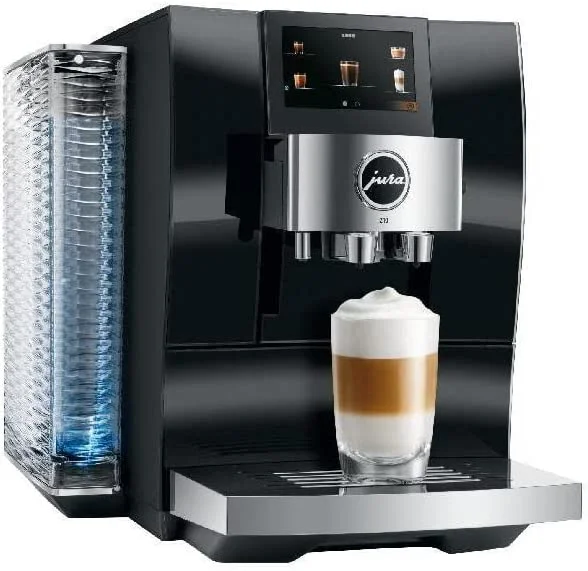
P.R.G. grinder built in, one-touch milk system, and Jura’s Cold Extraction Process for true cold brew. No dial-in, no wasted bags, no bad weeks.
Quick Answer
Buy the R58 if learning espresso is the point: a dual-boiler 58 mm E61 platform with dual PID control is a genuinely great instrument, handmade in Milan, that keeps rewarding skill for years - but budget a separate grinder, several sacrificed bags of beans, and 4-8 weeks before your shots stop being a coin flip. Buy the Z10 if the coffee is the point: one-touch espresso, milk drinks, and true cold brew that are equally good on day one and day one thousand, for a similar or lower all-in price once the R58’s learning curve is counted. Run your own assumptions in the calculator below - for most buyers, the learning-curve line is the one the sticker price hides.
Two Flagships, One Very Different Kind of Ready
Strip the marketing and these machines answer different questions about the same amount of money.
The Rocket R58 is an instrument you grow into. It is a dual-boiler machine, hand-built in Milan, with fully separate brew and steam boilers, each with its own PID controller and a detachable touchscreen for dialing in temperature, shot timing, and scheduling. It uses a commercial 58 mm E61 group head and a rotary pump with external pressure adjustment. None of that is automated. You supply a separate grinder, you dose and tamp, you pull the shot while judging it, and you steam milk by hand on a commercial-style wand. Every one of those steps is a skill, and every skill has a beginning where you are worse at it than you will be in a month.
The Jura Z10 is a flagship that is already finished. Press a button and the Product Recognising Grinder adjusts its grind to the specific drink you chose, the machine brews through Jura’s 3D brewing unit, and the HP3 milk system draws and froths milk automatically. Jura’s US product page lists 40 specialties, hot and cold, including true cold brew via the Cold Extraction Process. Our full Z10 review covers the machine in depth. There is no version of “the Z10 on day one” that is worse than “the Z10 in year three” - it is the same machine every single time.
This is our analysis, not a value judgment: the R58 asks you to become a better barista in exchange for a higher ceiling; the Z10 hands you the ceiling immediately and asks nothing of you at all. Which one belongs on your counter depends entirely on whether “becoming a better barista” sounds like the fun part or the tax.
Spec Table: Sourced, Side by Side
Prices below are approximate street prices at the time of checking and move often - use the price links for current figures. Sources for every figure are listed at the end of this article.
| Spec | Jura Z10 | Rocket R58 Cinquantotto |
|---|---|---|
| Type | Super-automatic (one-touch) | Semi-automatic prosumer dual boiler |
| Approx. price (machine only) | ~$3,300-$4,500 street | ~$3,500 |
| Grinder | Built in - P.R.G. auto-adjusts per drink | None - separate grinder required |
| Boiler config | Thermoblock, 15 bar pump | Dual boiler: 0.58 L brew + 1.8 L steam, dual PID (not a heat exchanger) |
| Group head | Internal, automatic dosing and tamping | Commercial 58 mm E61, heated |
| Pump | Internal vibration pump | Commercial rotary pump, external pressure adjustment, plumb-in capable |
| Milk | HP3 one-touch system, auto milk/foam switching | Commercial steam wand (manual), no milk automation |
| Cold drinks | Cold Extraction Process (true cold brew) | None - hot espresso over ice only |
| Water tank | 81 oz / 2.4 L | 2.5 L, convertible to direct plumb-in |
| Size (W x H x D) | 12.6 x 14.3 x 16.5 in | 12.2 x 16.5 x 17.3 in (machine only, before grinder) |
| Weight | 27 lbs | 64 lbs |
| Construction | Manufactured in Switzerland/Europe under Jura’s automated process | Hand-built in Milan, Italy |
One correction worth making up front, because it is a common mix-up in this exact price band: the R58 is not a heat-exchanger machine. Heat exchangers (like Rocket’s own Appartamento, lower in its lineup) use one boiler for both brewing and steaming, plumbed through an internal exchanger. The R58 has two fully separate boilers, each with its own PID - the same dual-boiler architecture as the Profitec MOVE and Rancilio Silvia Pro X, just at a higher price point with commercial-grade components like the rotary pump and heated E61 group.
The Learning-Curve Cost: What the Sticker Price Doesn’t Show
Here is the gap the spec table and the sticker price both hide. A Jura Z10 makes its best drink on the first morning you own it. A Rocket R58 does not - not because it is a worse machine, but because a manual dual-boiler is a skill, and skills have a beginning.
Nobody publishes a study on this, so treat the figures below as exactly what they are: anecdotal home-barista consensus and our own conservative estimate, not a cited statistic. Across forums, reviews, and barista-training accounts, the shape of the story is consistent even when the exact numbers vary:
- Wasted beans. Dialing in a new machine, a new grinder, and a new bag of beans all at once means grinding too fine and choking the shot, too coarse and gushing it, tamping unevenly, and pulling several shots that go down the drain or get grudgingly drunk before you land on a repeatable recipe. Home-barista consensus puts this at roughly 3-6 bags of beans partially or mostly sacrificed to the process - not every shot from those bags is wasted, but a meaningful share is.
- Wasted milk. The steam wand has its own separate learning curve. Early sessions commonly produce big bubbles instead of microfoam, scorched milk from over-steaming, or milk stretched too thin to texture properly - most new owners go through a carton or two of milk purely in steaming practice before the wand starts to feel predictable.
- Weeks to competence, not mastery. Getting to “I can reliably pull a good shot and steam usable milk” typically takes something like 4-8 weeks of regular practice for someone with no prior espresso background - faster with real focus and a few sessions a week, slower if you only touch the machine on weekends. Getting to genuinely great, consistent, latte-art-capable results takes considerably longer than that; this page only models the floor, not the ceiling.
None of this is a knock on the R58. A learning curve is the honest cost of an instrument with a real ceiling - the Z10 has no ceiling to climb because it has no floor to start from either. But a learning curve is still a cost, and it belongs in the same conversation as the sticker price.
Interactive Tool
The Learning-Curve Calculator: Is the R58 Still Cheaper?
Setup Prices (edit to match real quotes)
Your Learning Curve (edit if our estimates differ)
| Result | Rocket R58 | Jura Z10 |
|---|---|---|
| Machine + grinder setup | ||
| Learning-curve bean cost | ||
| Total to a consistently good shot | ||
| Which is cheaper, all in | ||
| Practice time before competence | ||
How the math works (no black box)
- R58 setup = machine price + grinder price. The $700 grinder default sits in the middle of the $500-$1,000 band a dual-boiler machine of this class is typically paired with.
- Learning-curve bean cost = bags spent learning x price per bag. This is our own conservative estimate framed as home-barista consensus, not a cited study - nobody publishes an official figure for this.
- R58 total = setup + learning-curve bean cost. This is the honest all-in price of reaching a consistently good shot, not just owning the machine.
- Z10 total = machine price only. The grinder is built in and there is no learning-curve cost to add - the first cup and the thousandth cup are the same drink.
- Practice time before competence = weeks to competence x practice hours per week, shown in total hours. This is separate from the dollar total - it is the time investment the R58 asks for that the Z10 does not.
- Excluded on both sides: milk wasted during steam-wand practice (real, but harder to price consistently - see the milk section below), accessories like a scale and tamper, beans and milk consumed after competence, and electricity.
With the defaults - a $3,500 R58, a $700 grinder, 4 bags at $18 sacrificed to dialing in - the R58’s all-in cost to a consistently good shot lands around $4,272, against a $3,999 Z10. The sticker-price advantage the R58 appeared to have is gone before you have made a single great cup, and that is before counting the 12 hours of practice (6 weeks at 2 hours a week, in the defaults) it took to get there. Change the defaults to a smaller grinder or a faster learner and the math can tip back toward the R58 - which is exactly the point of making it editable.
If the Learning Curve Decided It
The Z10 Skips the Practice Entirely
No wasted bags, no bad weeks, no separate grinder to shop for. Prices move often.
Milk: A Genuinely Powerful Wand vs One-Touch
This section deserves to be honest in both directions, because the R58’s steam side is not a weak point dressed up to sound competitive - it is a real strength.
Rocket R58: the 1.8-liter steam boiler is commercial-grade hardware borrowed straight from Rocket’s cafe machines, and what that means in practice is serious, sustained steam pressure with fast recovery between drinks - no waiting for a home machine to catch its breath mid-session. In practiced hands, a wand fed by a boiler this size produces true microfoam, the glossy, pourable texture that makes latte art possible, and it does so with more headroom than most home steam systems, including the Z10’s. That is a genuine, honest ceiling advantage, not a marketing claim. The floor, covered above, is that nobody starts there.
Jura Z10: drop the milk tube into cold milk, choose a drink, and the HP3 system handles grinding, extraction, and milk in one sequence, switching automatically between milk and foam for layered drinks. The result is very good and, more importantly for a household, identical every time from anyone, including a guest who has never used the machine before. The honest recurring cost is hygiene discipline - the milk circuit needs its short prompted rinse after milk drinks and a periodic deep clean with Jura’s milk system cleaner.
The pattern is the same one that runs through this whole comparison: the R58 offers a higher ceiling you must earn, one steaming session at a time; the Z10 offers a very good result nobody has to earn at all. If latte art specifically is the goal, the R58’s steam power is a real reason to accept the learning curve. If milk drinks are just something your household wants every morning without a production, the Z10’s ceiling is more than high enough and its floor never requires practice.
Where the R58 Wins
Being generous here is easy, because the R58 is a genuinely capable machine.
- Espresso ceiling. A commercial E61 group, dual-boiler PID stability, a rotary pump with external pressure adjustment, and a quality separate grinder give you control over every variable that matters. Dialed in on good beans, this platform can produce shots no super-automatic - the Z10 included - can match. The Z10’s extraction is excellent and consistent, but it is a preset; the R58’s is whatever you are capable of.
- Steam power. The 1.8-liter steam boiler outclasses any home automatic milk system for texture ceiling, recovery speed, and back-to-back capacity. If latte art is a real goal, only one of these machines can take you there.
- Serviceable, standard parts. A 58 mm E61 platform means baskets, gaskets, and portafilter parts are widely available and largely owner-serviceable with basic tools. A machine like this is built to be rebuilt, not replaced.
- Simultaneous brew and steam. Two fully independent boilers mean you can pull a shot and steam milk at the same time, cafe-style - the Z10 sequences everything automatically, which is effortless but not faster for one drink at a time.
- Craft and ownership. Hand-built in Milan, with a detachable touchscreen and real mechanical presence on the counter. For someone who wants espresso as a hobby, this is a genuinely rewarding machine to own and to keep improving at.
Where the Jura Z10 Wins
- Zero learning curve. No sacrificed bags of beans, no wasted milk, no weeks of inconsistent shots. The first cup and the thousandth cup are the same drink, from anyone in the household.
- True all-in cost. Once the grinder and the learning-curve cost are counted, the R58’s sticker-price edge shrinks or disappears entirely - the calculator above shows exactly where that crossover sits with your own numbers.
- Cold brew. The Cold Extraction Process has no answer on the manual side at any price. If cold drinks are part of your routine, this alone can decide the comparison.
- Milk drinks at one touch. For a household making several milk drinks a day, this is the difference between a button press per person and a steaming lesson per person.
- Drink range. Espresso to flat white to true cold brew specialties from one touchscreen. On the R58, every drink beyond espresso is a manual recipe you execute by hand.
- No dial-in tax on new beans. Every new bag on the Z10 is just a new bag. On the R58, every new roast level or origin can mean re-dialing the grind, which is part of the ongoing cost of ownership, not a one-time event.
The Verdict
The Rocket R58 is the better espresso machine in the narrow, purist sense: a real dual-boiler platform, commercial-grade components, and a ceiling that keeps rewarding skill for years. The Z10 is the better coffee system in the broad sense: a similar or lower all-in cost once the learning curve is counted, a fraction of the effort, and a cold brew capability the manual world cannot answer at any price.
The question this page keeps circling back to is not “which machine is better.” It is: do you want to learn espresso, or do you want to drink it? If the idea of six weeks spent dialing in a grinder, wasting a few bags of beans, and steaming your way through a carton of milk sounds like the fun part of owning a flagship machine, buy the R58 and enjoy the climb - nothing Jura makes offers that climb at all. If you would rather the flagship-quality drink just show up, correctly, from the first morning, the Z10 is the machine this comparison keeps pointing at.
This page’s framework - the dollar-and-hour cost of learning a manual machine - is deliberately narrower than our companion comparisons. Our Jura Z10 vs La Marzocco Linea Mini piece models total setup cost and weekly active time for an already-competent user, not the cost of becoming one; read that page for the ongoing-ownership math once you are past the learning curve modeled here. Our Jura E8 vs Rancilio Silvia Pro X comparison owns the weekly hands-on-time model at a lower price band, and our Jura E8 vs Profitec MOVE comparison owns the full setup-cost-plus-counter-space accounting at that same lower band. All four pages describe the same convenience-versus-craft fork in the road; this one is the only one that prices what it costs to get good at the craft in the first place.
FAQ
Is the Rocket R58 better than the Jura Z10?
As a pure espresso instrument, yes - a dual-boiler machine with a 58 mm E61 group, dual PID control, and a good separate grinder has a quality ceiling no super-automatic reaches. As a daily result, the Z10 is better: one-touch espresso, milk drinks, and true cold brew with zero learning curve. They are opposite answers to a similar price.
Is the Rocket R58 a heat exchanger machine?
No. The R58 is a dual-boiler machine with fully separate, independently PID-controlled brew and steam boilers, not a heat exchanger. Rocket’s heat-exchanger models sit lower in its lineup, such as the Appartamento. The R58 shares its boiler architecture with machines like the Profitec MOVE and Rancilio Silvia Pro X.
How much does it really cost to learn the Rocket R58?
There is no official figure. Home-barista consensus and our own conservative estimate put it at 3-6 bags of beans partly sacrificed to dialing in, spread over roughly 4-8 weeks of regular practice, before shots are consistently good. At $18-$22 a bag, that is $70-$130 in beans alone, on top of the machine and grinder. The calculator above lets you run your own numbers.
Do I need a separate grinder with the Rocket R58?
Yes. There is no built-in grinder, and a dual-boiler machine of this class needs a serious burr grinder - typically $500-$1,000 or more - to perform as designed. The Z10’s P.R.G. grinder is built in and adjusts itself per drink.
Which machine is better for lattes and cappuccinos?
The R58 has the higher ceiling: its 1.8-liter steam boiler and commercial wand can produce true microfoam once you have the technique. The Z10 makes consistent one-touch milk drinks with zero technique. Households making several milk drinks a day almost always live better with the Z10.
Decided the Result Beats the Ritual?
Jura Z10 - No Grinder to Buy, No Curve to Climb
Built-in P.R.G. grinder, one-touch milk, hot and cold specialties, and a consistently good cup starting with your first one. Prices move often - check the current one.
Check Z10 Price on Amazon →For how the Z10 and the rest of the Jura lineup stack up against other brands, see our full competitor comparison guide.
All prices are approximate list or street prices that change frequently - use the price buttons on this page for current figures. The learning-curve figures (bags of beans sacrificed, weeks to competence, wasted milk) are stated throughout as our own conservative estimate and home-barista consensus, not a cited study - no manufacturer or independent lab publishes a learning-curve statistic for manual espresso machines. Espresso and milk quality statements for both machines are reasoned from confirmed hardware specifications and manufacturer descriptions, not from hands-on testing of the Rocket R58. Specifications last checked: July 2026.
One-Touch Flagship
Jura Z10
P.R.G. grinder, hot and cold specialties, one-touch milk.
Check Z10 Price on Amazon →Dual-Boiler Icon
Rocket R58 Cinquantotto
Dual PID, commercial E61 group - bring your own grinder.
Check Price on Amazon →As an Amazon Associate, we earn from qualifying purchases at no extra cost to you.