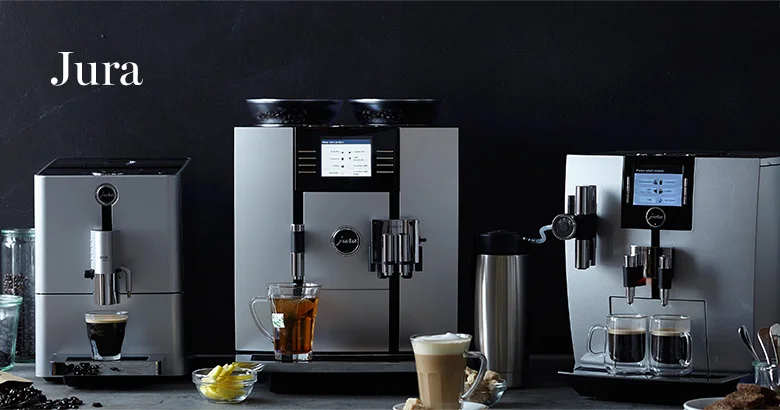
A bean-to-cup coffee machine grinds fresh beans for every drink at the touch of a button - no pods, no manual steps, no barista required. For an office, that means consistently good coffee for the whole team without daily management overhead. Jura makes the best bean-to-cup machines for office use, with two models built specifically for professional environments - the WE8 and the GIGA 6 - plus several home models that cross over well into small team settings.
Choosing the right bean-to-cup machine for your office comes down to three things: how many people use it daily, how many drinks per day you need, and whether you need a professional-grade machine or if a home model will do.
| Machine | Best for | Daily capacity | Price (approx.) | |
|---|---|---|---|---|
| Jura WE8 | Small offices, 5-15 people | 30-50 drinks/day | ~$1,499-$1,799 | Check Price → |
| Jura GIGA 6 | Medium offices, 15-30 people | 50-100 drinks/day | ~$3,499-$3,999 | Check Price → |
| Jura S8 | Small team or home office, 2-8 people | 15-25 drinks/day | ~$1,499-$1,699 | Check Price → |
| Jura E8 | Home office or very small team, 1-4 people | 8-15 drinks/day | ~$1,399-$1,599 | Check Price → |
Jura WE8 - Best for Small Offices (5-15 People)
The WE8 is Jura’s flagship professional machine for small office environments. It is the machine Jura built specifically for this use case - not a home machine pushed into office duty.
The key differences from home Jura machines: the WE8 has a larger 3L water tank (vs 1.9L on the E8 and S8), a commercial-grade brew group designed for higher daily throughput, and a user management system that tracks maintenance cycles more aggressively. It also has a stainless steel front panel that handles fingerprints and daily wear better than the piano-black finish on consumer models.
Drink output: The WE8 comfortably handles 30-50 drinks per day without performance degradation. For a 10-person team making 3-5 drinks each, you will not hit the ceiling.
Specialties: 12 one-touch specialties including espresso, ristretto, lungo, coffee, cappuccino, latte macchiato, flat white, and specialty milk drinks. The HP3 fine-foam milk system produces the same silky microfoam as the home E8.
WiFi + J.O.E. app: The WE8 includes WiFi connectivity and full J.O.E. app support. In an office context, this is genuinely useful - the administrator can monitor machine status, maintenance intervals, and consumption data remotely.
Maintenance: The WE8 prompts for cleaning and descaling more frequently than home models, reflecting higher use. Budget for cleaning tablets and descaling products monthly rather than every 2-3 months. See our cleaning products guide for the right supplies.
Best for: Small professional offices, reception areas, agency kitchen setups, any environment where 5-15 people share one machine.
Best for Small Offices
Jura WE8
3L tank, 30-50 drinks/day capacity, HP3 fine foam, WiFi management. Built for professional use.
Jura GIGA 6 - Best for Medium Offices (15-30 People)
The GIGA 6 is Jura’s answer for environments where the WE8’s throughput is not enough. Dual grinders, dual boilers, and a 2.6L water tank allow it to produce 50-100 drinks per day without the slowdowns you would see in a single-boiler machine under this kind of load.
The dual-grinder setup is particularly useful in a mixed office: one grinder can be set to a regular espresso blend, the other to a milder filter-coffee setting. This means the machine can simultaneously serve espresso purists and people who want a simple cup of coffee without reconfiguring anything between drinks.
Specialties: 15 one-touch specialties. The GIGA 6 handles every drink type the WE8 does and adds a few specialized options.
Why the GIGA 6 over GIGA 10 for most offices: The GIGA 10 adds cold brew capability and a larger 4.3” touchscreen. For pure office coffee use, these additions are hard to justify at the price premium. The GIGA 6 delivers equivalent hot drink performance at lower cost.
Maintenance in a high-volume office: At 50-100 drinks/day, expect to run cleaning cycles every 3-5 days and descale every 6-8 weeks. Budget accordingly - CLARIS filter changes will also be more frequent. See our maintenance guide for the full schedule.
Best for: Open-plan offices, hospitality spaces, larger teams where the shared machine gets heavy use throughout the day.
Best for Medium Offices
Jura GIGA 6
Dual grinders, dual boilers, 50-100 drinks/day. The right choice when the WE8 isn’t enough.
Jura S8 - Best for Small Teams or Home Office (2-8 People)
The S8 is a home machine, not a professional one - but it handles small team use well. If you have a 2-8 person team and want a premium coffee experience without stepping up to the WE8’s price, the S8 is a legitimate option.
The S8’s advantages over the E8 in an office context: the J.O.E. WiFi app lets users program personal drink preferences from their phone, which reduces friction in a shared-use environment. The 4.3” touchscreen is easier for multiple users to navigate than the E8’s rotary selector. And the HP3 milk system delivers the same fine-foam quality as the WE8.
Honest limitations: The S8 has a 1.9L water tank - the same as the home E8. In a team of 8 making 3 drinks each, you will refill the tank 2-3 times per day. It is a home machine being used harder than intended. Manageable, but not ideal.
Best for: Home offices, small startup teams, meeting room setups where volume stays under 20 drinks per day.
Home/Small Office Crossover
Jura S8
WiFi app, 4.3” touchscreen, HP3 fine foam. Home machine that handles small team use well.
Jura E8 - Best for Home Office (1-4 People)
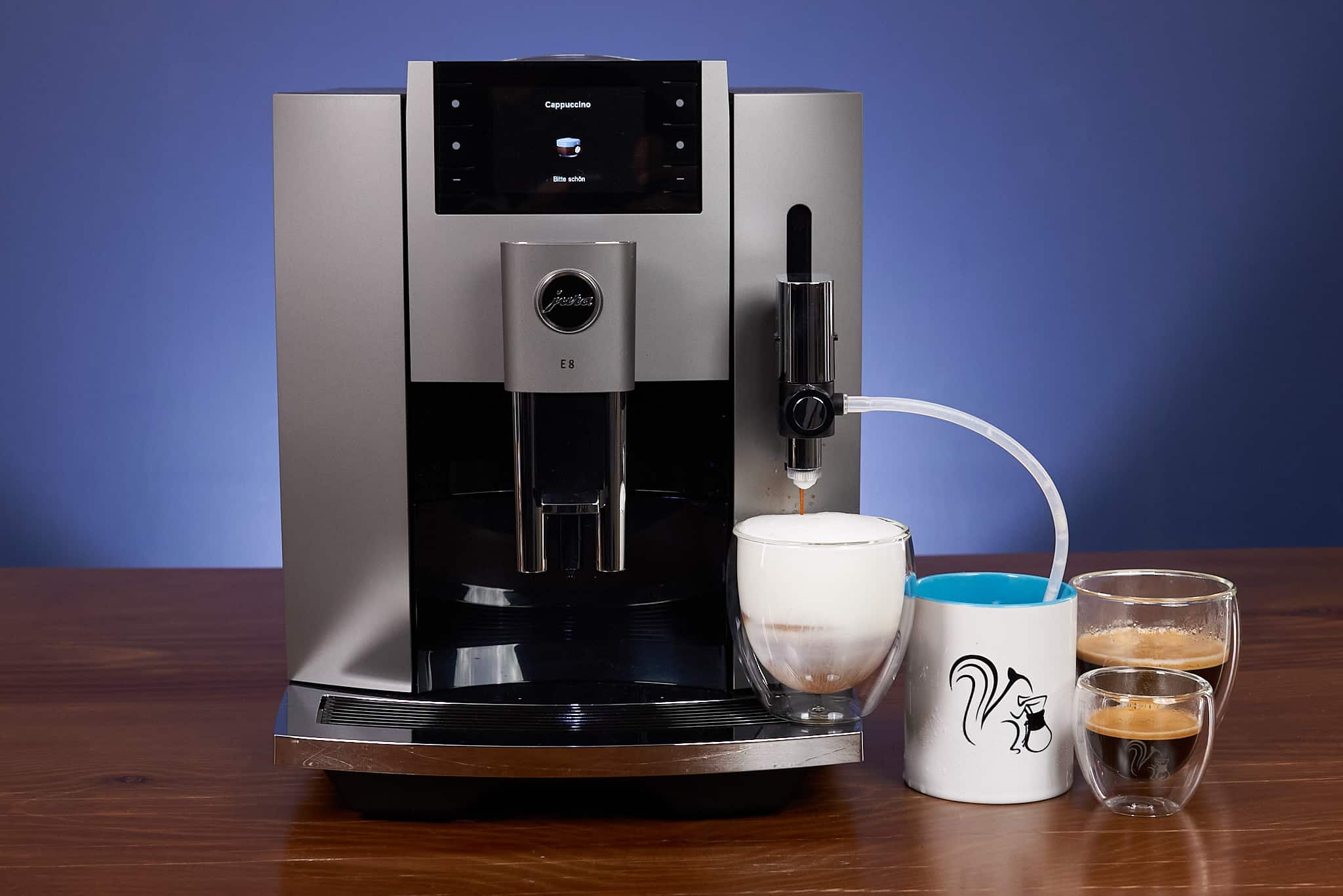
If you work from home and want a premium machine that also occasionally serves a couple of colleagues, the E8 is the right choice. It is Jura’s best-value home machine with 17 specialties, the Aroma G3 grinder, and HP3 fine foam - but it is designed for household use, not team use.
At 2-6 drinks per day, the E8 is in its ideal operating range. Push it to 15-20 drinks daily and the 1.9L tank and smaller hopper become daily management tasks. For a solo home office or 2-person remote team, it is more than sufficient.
See our full Jura E8 review for the detailed breakdown.
How to Choose: The Office Size Rule of Thumb
| Team size | Right machine | Why |
|---|---|---|
| 1-4 people | Jura E8 | Home machine in its ideal range |
| 4-8 people | Jura S8 | WiFi app helps with shared use |
| 8-20 people | Jura WE8 | Built for this exact use case |
| 20+ people | Jura GIGA 6 | Dual boilers prevent bottlenecks |
Beyond team size, consider:
- Do you need milk drinks? All four machines above support milk. The WE8 and S8 handle heavier milk use better due to their milk system quality and throughput.
- Who manages maintenance? In an office, no one is usually “in charge” of the coffee machine. Jura machines auto-prompt for maintenance, which makes them the lowest-friction option for shared use.
- Budget per year: Beyond the purchase price, factor ~$150-$300/year in consumables for a small office machine (cleaning tablets, descaling tablets, CLARIS filters). This scales up with usage volume.
How Many Cups Does Your Office Actually Need? (Worksheet)
Team size is a proxy. What actually determines whether a machine works for your office is two numbers: total cups per day, and how many of those cups land in your busiest hour. Offices do not drink coffee evenly - in most workplaces, 30-50% of the day’s coffee happens in one morning window, typically between 9:00 and 10:30. A machine that handles your daily total with ease can still create a queue at 9:15.
The formula is simple enough to do on a napkin:
The two numbers that matter
- Daily cups = coffee drinkers × cups per person per day
- Peak-hour cups = daily cups × peak-window share (the fraction of the day’s coffee drunk in the single busiest hour)
Or let the worksheet below do it. Change any field and the results update instantly.
Interactive Worksheet
Office Coffee Demand Calculator
Daily demand
25 cups/day
Busiest hour
10 cups/hour
| Machine class | Est. sustained output | Comfort ceiling | Fit for your numbers |
|---|---|---|---|
| Jura E8 / S8 (home class) | ~15 cups/hour | ~20 cups/day | |
| Jura WE8 (professional) | ~20 cups/hour | ~50 cups/day | |
| Jura GIGA 6 / GIGA 10 | ~25 cups/hour | ~100 cups/day |
How the math works (no black box)
- Daily cups = drinkers × cups per person per day.
- Peak-hour cups = daily cups × peak share. 40% is a typical office default; raise it if your team all arrives at the same time.
- Sustained output figures are our estimates, not manufacturer ratings. Jura does not publish cups-per-hour numbers. We assume 2 to 2.5 minutes per one-touch milk drink and 1 to 1.5 minutes per black coffee, plus rinse cycles and the real-world gaps between people at the machine. Single-boiler home machines also pause between milk and coffee phases; the dual-boiler GIGA line does not, which is where its higher estimate comes from.
- Fit verdict: “Over capacity” if either your daily total or your peak hour exceeds the ceiling; “Tight” if you are within 20% of it; “Comfortable” otherwise.
The Refill Burden: What Tank and Hopper Sizes Mean Day to Day
Capacity specs look abstract until you translate them into how many times per day someone on your team has to walk over and refill water, top up beans, or empty the grounds drawer. In an office, every one of those is an interruption - and if nobody owns the job, the machine simply stops mid-morning with a “fill water tank” message.
Here is that translation, using the manufacturer capacities for each machine (sources in the box at the end of this article) and three usage levels:
| Machine | Water / beans / grounds | 30 cups/day | 60 cups/day | 100 cups/day |
|---|---|---|---|---|
| Jura E8 / S8 | 1.9L / 280g / ~16 pucks | ~6/day (3 water, 1 beans, 2 grounds) | ~12/day (beyond intended use) | Not viable |
| Jura WE8 | 3.0L / 500g / ~25 pucks | ~4/day (2 water, 1 beans, 1 grounds) | ~7/day (4 water, 1 beans, 2 grounds) | ~12/day (beyond WE8 comfort zone) |
| Jura GIGA 6 / GIGA 10 | 2.6L / 2×280g / ~20 pucks | ~5/day (2 water, 1 beans, 2 grounds) | ~8/day (4 water, 1 beans, 3 grounds) | ~14/day (7 water, 2 beans, 5 grounds) |
Our assumptions, stated in full: roughly 6 oz (about 177 ml) of water drawn per drink including automatic rinse cycles, about 10 g of beans per drink, and one spent puck per drink. An “intervention” is one water refill, one hopper top-up, or one grounds-drawer empty, rounded to whole events. Real numbers shift with drink mix - long coffees use more water, ristrettos less - so treat these as planning figures, not guarantees.
Two things jump out of that table. First, the WE8’s larger tank and hopper are not marketing: at 30 cups/day it needs roughly a third fewer interventions than a home machine, and interventions are exactly what nobody in an office wants to own. Second, no tank-filled machine escapes the treadmill at 100 cups/day. Even the GIGA class needs someone touching it roughly every 30-40 minutes at that volume, which is your signal to read the section below on plumbed machines.
Size for the Peak Hour, Not the Daily Average
The most common office coffee mistake is sizing for the daily average. Averages hide the queue.
Worked example: a 12-person office where everyone averages 2.5 cups is 30 cups/day. Spread over a 9-hour day that is barely 3-4 cups per hour - on paper, even an E8 shrugs at it. But if 40% of those cups happen in the 9:00-10:00 window, the machine actually faces 12 back-to-back drinks in one hour. By our throughput estimates a home S8 running flat out - grinding, brewing, steaming, rinsing between milk drinks - lands at roughly 15 drinks/hour with zero slack, so a queue forms, and the fifth person in line goes back to their desk without coffee. The WE8, at an estimated ~20 cups/hour, absorbs the same rush with room to spare.
The rule that follows: pick the machine whose sustained hourly output covers your peak hour with roughly 50% headroom, not the one that merely covers your daily total. Headroom is what keeps the queue moving when three people show up at once, when someone runs a cleaning cycle at the wrong time, or when the team grows by a quarter next year - all three of which will happen.
When Jura Stops Being the Right Answer
We sell Jura machines through the links on this page, so take this section as the honesty check: above a certain volume, no tank-filled countertop machine is the right tool, Jura included.
The practical ceiling for the machines in this guide is roughly 100 cups/day, or a peak hour approaching 25-30 drinks. Past that point you are fighting physics: tanks empty every half hour, grounds drawers fill faster than anyone empties them, and a single brew group runs hot all day. What that kind of volume actually calls for is the commercial machine class - plumbed directly into a water line, built around larger boilers and higher-duty-cycle internals, and almost always sold with a service contract rather than a shopping-cart checkout. The established names in that class are Franke, WMF, and Thermoplan (Thermoplan builds the machines behind a certain global coffee chain), plus Jura’s own GIGA X professional line sold through office coffee service dealers. We do not review those machines directly - they are quoted, installed, and maintained by distributors, and comparing them on specs without a service contract attached would mislead you, though our full breakdown of where that ceiling sits and what to buy above it covers the decision in more detail. If your worksheet numbers above land in “Over capacity” for every row, call an office coffee service provider, not Amazon.
If your volume is high but still inside the tank-filled world - say 60-100 cups on busy days - the GIGA 10 is the most machine Jura will sell you off the shelf: the same dual-grinder, dual-boiler platform as the GIGA 6 with cold brew specialties added on top. See our GIGA 10 vs Franke A300 comparison for exactly where that handoff to commercial equipment happens.
The Ceiling of the Tank-Filled Class
Jura GIGA 10
Dual grinders, dual boilers, cold brew specialties. The last stop before plumbed commercial machines.
Office Maintenance Essentials
Shared office machines need more frequent maintenance than home machines. Stock these:
Most Frequent
Cleaning Tablets
Every 1-3 weeks in an office setting. Keep a pack in the kitchen drawer.
Shop on Amazon →Monthly
Descaling Tablets
Every 4-8 weeks depending on water hardness and usage volume.
Shop on Amazon →Every 6-8 Weeks
CLARIS Filter
Reduces scale and protects the machine. Replace more often in hard water areas.
Shop on Amazon →Our top office pick
Jura WE8 - Purpose-Built for Office Use
3L tank, 30-50 drinks/day capacity, HP3 fine foam, WiFi fleet management, professional-grade durability. The right machine for 5-20 person teams who want premium coffee without daily maintenance headaches.
Check WE8 Price on Amazon →As an Amazon Associate, we earn from qualifying purchases at no extra cost to you.
FAQ
What is the best bean-to-cup machine for a 10-person office?
The Jura WE8 is the best fit for a 10-person office. It handles 30-50 drinks per day comfortably, has a 3L water tank built for professional use, and includes WiFi management through the J.O.E. app. Home machines like the E8 or S8 require multiple daily water tank refills at this usage level and are not built for this throughput long-term.
Is a bean-to-cup machine worth it for an office?
Yes, for offices with more than four regular coffee drinkers. Bean-to-cup machines grind fresh for every drink, require no per-drink manual effort, and produce consistent quality that pod machines cannot match. The maintenance cost - roughly $150-$300 per year in consumables for a small office machine - is offset within a few months compared to regular coffee shop runs for a team.
How many cups per day can an office coffee machine handle?
It depends on the model. The Jura WE8 handles 30-50 drinks per day, the GIGA 6 handles 50-100, and home crossover models like the S8 and E8 are comfortable at 15-20. Exceeding these limits shortens maintenance intervals and can cause premature wear on the brew group and milk system.
What maintenance does an office coffee machine need?
Office machines need more frequent maintenance than home machines due to higher daily use. Expect cleaning tablet cycles every 1-3 weeks (vs every 200 cups at home), descaling every 4-8 weeks, and CLARIS filter changes every 6-8 weeks. Jura machines prompt for all of these automatically, which reduces the burden on whoever manages the machine.
See also: Jura GIGA 6 vs GIGA 10 | Jura E8 Review | Best Jura Cleaning Tablets | Maintenance Guide