We earn a commission when you buy a Jura through our links, which is exactly why this page exists: the fastest way to lose your trust would be to sell you a Jura for a job no Jura can do. Jura’s machines are excellent up to a real, nameable ceiling. This page names it, shows the math behind it, and tells you what actually sits above it - Franke, WMF, Thermoplan, and Jura’s own dealer-channel GIGA X line.
Quick Answer
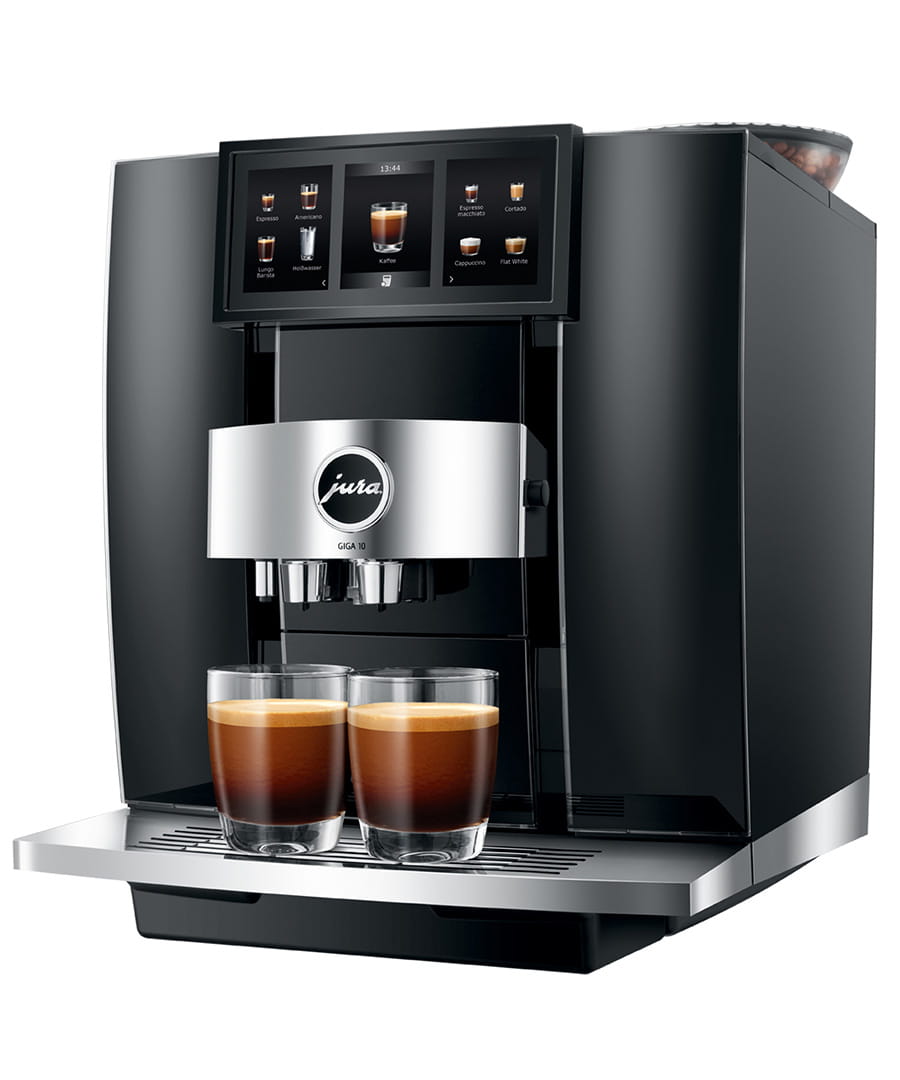
Every Jura you can buy at retail is a tank-filled machine, and by our planning math the class tops out around 100 cups per day - with the busy hour usually breaking the machine’s back before the daily total does. Under that ceiling, the GIGA 10 is the most machine Jura sells. Above it, you are shopping for plumbed commercial equipment that is quoted, installed, and serviced by dealers - not added to a cart.
The Honest Ceiling: Why Every Tank-Filled Machine Tops Out
Three separate walls define the ceiling, and a busy venue hits all three at once.
Wall 1: The tank
Every retail Jura draws water from a tank you fill by hand and drops pucks into a drawer you empty by hand. That is fine at home. At volume it becomes a treadmill: in our office capacity analysis, a GIGA-class machine running at 100 cups per day needs a water refill, hopper top-up, or grounds-drawer empty roughly every 30 to 40 minutes. Commercial machines dissolve this wall with plumbing. Franke’s A300, for example, is built for either a mains water connection or a 4.8 liter tank, and the plumbed configuration includes a drain hose - water in, waste water out, nobody carrying a tank to the sink. That is not a luxury feature; at volume it is the difference between a machine that serves the rush and a machine that interrupts it.
Wall 2: The duty cycle
Manufacturer ratings tell the story bluntly. WMF states its 1500 S+ - the smaller end of its commercial range - is designed for up to 180 cups per day. Franke publishes standardized hourly throughput for the international A300 of up to 124 espressos per hour from a single spout (163 in parallel operation, per the DIN 18873 test standard). A dealer listing for Thermoplan’s Black&White4 CTS rates it at up to 240 espressos per hour. Against that, our own estimate for the fastest Jura sold at retail - the dual-boiler GIGA line - is roughly 25 cups per hour sustained, and Jura publishes no cups-per-hour rating at all for these machines. These are different classes of machine: larger boilers, heavier brew groups, and internals engineered to run at pace all day rather than in household bursts. The commercial figures above are manufacturer and dealer ratings under standardized or ideal conditions, not our testing, but even discounted heavily they sit an order of magnitude above the tank-filled class.
Wall 3: The service model
A retail Jura is a parcel: it arrives in a box, and if it breaks you ship it to a service center and live without coffee for a week or two. A commercial machine is a relationship: it is quoted by a dealer, installed by a technician, and covered by a service contract with defined response times, because a cafe that cannot make coffee is not a cafe. Thermoplan machines reach Starbucks stores worldwide this way - the company has been Starbucks’ exclusive espresso machine supplier since 1999 per press reporting - and nobody at Starbucks has ever mailed one back in a box. If downtime costs you revenue by the hour, the service model is not a footnote. It is most of the decision.
The Decision-Threshold Table
This is the whole page in one table. Find your cups-per-day band, check the peak-hour column, and note that the peak hour disqualifies machines before the daily total does. Every assumption behind it is stated below the table.
| Cups per day | Peak hour (at 40% share) | Machine class | What that means in practice |
|---|---|---|---|
| Up to 20 | up to ~8 drinks | Home super-automatic | E8, S8, or C9. Comfortable, with headroom. |
| 20-50 | ~8-20 drinks | Office-grade tank super-automatic | WE8 (3L tank, built for this). The top of the band already runs near our ~20/hour WE8 estimate. |
| 50-100 | ~20-40 drinks | GIGA class - top of the tank-filled world | GIGA 6 or GIGA 10, and only if your peak hour stays under roughly 25-30 drinks. At a 40% morning share, a 100-cup day breaches the peak ceiling even though the daily total fits. |
| 100-200 | ~40-80 drinks | Plumbed commercial, entry tier | Jura GIGA X8c (dealer channel), Franke A-line, WMF 1500 S+ class (WMF rates it for up to 180 cups/day). Quoted, installed, serviced. |
| 200+ | 80+ drinks | High-duty commercial | Thermoplan Black&White4 class (dealer-rated up to 240 espressos/hour). This is chain-cafe equipment. |
Our assumptions, stated in full
- Peak-hour share: most venues serve 30-50% of the day’s coffee in one busy window; the table uses 40%. If your rush is sharper (a bakery at 8am), size for the peak column, not the daily one.
- Jura-side throughput is our analysis, not Jura’s. Jura publishes no cups-per-hour ratings. Our planning estimates - E8/S8 ~15 cups/hour, WE8 ~20, GIGA ~25, with daily comfort ceilings of ~20/50/100 - are built from tank, hopper, and brew-cycle math, worked in full in our office capacity guide.
- Commercial-side figures are manufacturer or dealer ratings (WMF’s 180 cups/day, Franke’s DIN 18873 hourly figures, Thermoplan’s dealer-listed hourly rates), produced under standardized or ideal conditions. We have not load-tested any of these machines.
- Refill interventions: a tank machine at its ceiling needs human attention every 30-40 minutes (water, beans, or grounds). Plumbed machines remove the water half of that entirely.
- Headroom rule: whatever class the table puts you in, buy the machine whose sustained output covers your peak hour with about 50% to spare. Demand grows; brew groups do not.
Band by Band: What We Would Actually Buy
Up to 20 cups per day - a home Jura, honestly bought. A household, a home office, a 2-4 person team. This is the E8/S8/C9 zone and the machines are genuinely great at it. Our office guide covers the picks in detail.
20-50 cups per day - the WE8 zone. This is the band where people mistakenly buy a second home machine. Do not: the WE8’s 3L tank and professional-grade brew group exist precisely for this duty, and the refill math favors it heavily over an S8 pressed into office service.
50-100 cups per day - the GIGA class, with eyes open. A GIGA 6 comfortably carries a small cafe at 20-40 cups per day, consistent with our cafe recommendations, and the class stretches to around 100 on our estimates. Two honest warnings. First, the peak hour: at a 40% morning share, a 100-cup day means 40 drinks in one hour against our ~25/hour GIGA estimate - the queue breaks before the daily total does. Second, the labor: at the top of this band someone touches the machine every half hour. If both warnings apply to you, read the next section instead of buying two GIGAs.
Small Cafe / Busy Office
Jura GIGA 6
Dual grinders, dual thermoblocks. Our pick for 20-40 cups/day when the peak hour stays sane.
Check Price on Amazon →Top of the Tank Class
Jura GIGA 10
Dual grinders, dual boilers, cold brew specialties. The most machine Jura sells at retail.
Check Price on Amazon →100 cups per day and up - stop shopping retail. Everything past this line is the plumbed commercial class, and it is bought differently, which the rest of this page explains.
What Sits Above Jura: The Plumbed Commercial Class
Four names come up when a venue outgrows the tank-filled world. We do not sell any of them, and we have not tested them - what follows is what the manufacturers and their dealers state, plus our analysis of where each one beats a Jura.
Jura’s own GIGA X line (the exit that stays in the family)
Jura itself agrees there is a ceiling, because Jura builds machines above it: the GIGA X professional line, sold not at retail but through Jura Professional dealers and office coffee service distributors. The GIGA X8c, for example, is Jura’s speed-focused professional machine with a permanent water connection - the plumbed configuration no retail Jura offers. If your operation loves the Jura workflow but has outgrown the tank, this is the natural conversation to have with a Jura Professional dealer. Where it wins over a GIGA 10: the water line, the professional service channel, and a platform built for continuous duty rather than household bursts.
Franke (the Swiss foodservice heavyweight)
Franke Coffee Systems builds the machines behind countless hotel breakfast bars and convenience-store coffee corners. Its compact A300 illustrates the class: mains water connection or 4.8L tank, a refrigerated milk cooling unit, automated cleaning, and standardized throughput ratings (124 espressos per hour single-spout under DIN 18873 for the international variant) that no tank machine approaches. One nuance for US buyers: Franke’s US channel currently sells the A300 as the “Fresh Brew” configuration - a brewed-coffee machine, not an espresso machine - in plumbed or reservoir versions, with espresso-based models sitting elsewhere in its A-line. Where Franke wins: throughput ratings, fleet telemetry, automated milk hygiene, and NSF-conforming foodservice certification on its US equipment. We compare the closest matchup directly in Jura GIGA 10 vs Franke A300.
WMF (the numbers company)
WMF Professional Coffee Machines publishes exactly the number Jura never does: recommended daily capacity. The 1500 S+ is rated for up to 180 cups per day, and WMF pitches it at bakeries, larger offices, convenience stores, and hotels. That one published figure is worth pausing on - it is roughly double our estimated ceiling for a GIGA, and it is WMF’s smaller machine. Where WMF wins: honest published capacity ratings, a machine range that scales far past 180 cups, and a dealer service network built for venues that cannot be without coffee.
Thermoplan (the machine behind the mermaid)
Thermoplan is the Swiss manufacturer that has supplied every Starbucks worldwide with its espresso machines since 1999, per press reporting - which is about the strongest duty-cycle credential that exists. A dealer listing for its Black&White4 CTS rates it at up to 240 espressos or 200 brewed coffees per hour. Machines in Thermoplan’s range were reported by SWI swissinfo.ch to run roughly $7,000 to $17,000 before installation and service - a useful ballpark for what real commercial capacity costs. Where Thermoplan wins: it is simply a different sport. Nobody cross-shops a GIGA 10 against a Black&White4; you graduate to one.
What Commercial Procurement Actually Looks Like
If the table put you above 100 cups per day, here is the process you are actually entering - because it is nothing like buying a Jura from Amazon.
There is no cart. Franke’s US site routes you to a quote request; WMF and Thermoplan sell through distributors; Jura Professional works through office coffee service dealers. Expect a conversation about your volume, drink mix, and site before anyone names a number, and expect the number to bundle equipment, installation, and service.
There is a site survey. Plumbed machines have real installation requirements. Franke’s A300 documentation is a good preview of the checklist: a dedicated water supply at 0.8-8.0 bar pressure, drinking-water quality (explicitly not from a household softener), minimum flow rate, a drain line, and adequate electrical service. Someone will look at your counter, your water, and your panel before quoting.
There is a service contract, and it is the point. Response times, preventive maintenance visits, loaner or swap arrangements - this is what you are actually buying, wrapped around a machine. Our own cafe guidance recommends professional servicing even for a GIGA; in the commercial class it stops being a recommendation and becomes part of the purchase.
Budget honestly. We will not invent prices where manufacturers publish none. The only sourced ballpark we can offer is the reported $7,000-$17,000 range for Thermoplan machines - and installation, water treatment, and the service agreement land on top. If a quote seems steep next to a $4,000-range GIGA, remember what the quote includes that the box does not: plumbing, uptime guarantees, and someone who answers the phone during your morning rush.
A word on used commercial equipment. It exists and it is cheaper, but a plumbed machine without a service relationship is a boat without a marina. If you go this route, arrange the service contract first and let the servicer bless the specific machine before you pay for it.
If You Are Under the Ceiling
Most readers who land on this page are not actually above 100 cups per day - they are a growing office or a small cafe sitting safely inside the GIGA band and wondering how much headroom they have. If the threshold table put you there, the answer is the same one we give in our GIGA 10 review: buy the most machine Jura sells at retail and enjoy that it needs no plumber, no site survey, and no contract.
Under 100 Cups a Day?
Jura GIGA 10 - The Last Stop Before Plumbed Commercial
Dual grinders, dual boilers, 36 specialties including cold brew. The most capacity you can buy without a dealer quote.
And if you are choosing between staying automatic or going to a traditional barista setup instead, our super-automatic vs semi-automatic comparison covers that fork in the road. For how Jura compares against other brands generally, see our full competitor comparison guide.
FAQ
How many cups per day can a Jura machine actually handle?
By our planning estimates: home machines like the E8 and S8 are comfortable up to about 20 cups per day, the office-grade WE8 handles 30-50, and the GIGA 6 and GIGA 10 top out around 100. Jura does not publish cups-per-hour ratings, so these are our estimates built from tank, hopper, and brew-cycle math (worked in full in our office capacity guide), not manufacturer figures. Above roughly 100 cups per day, no tank-filled Jura is the right tool.
Can I plumb a Jura into a water line?
Not any machine Jura sells at retail - the GIGA 10 and everything below it are tank-filled only. Jura does build plumbed machines: the GIGA X professional line, such as the GIGA X8c with a permanent water connection. But those are sold through Jura Professional dealers and office coffee service distributors with installation and service arrangements, not through a retail checkout.
What does a plumbed commercial coffee machine cost?
There is usually no list price. Franke, WMF, and Thermoplan equipment is quoted by dealers based on configuration, installation, and the attached service contract. For scale, press reporting on Thermoplan puts its machines roughly between $7,000 and $17,000 before installation and service. Treat every number as a ballpark until you hold a written quote.
Is a Jura GIGA 6 enough for a small cafe?
At 20-40 cups per day, yes - the same guidance we give in our cafe recommendations. The caveat is the peak hour: if most of those cups land in one morning window, the queue forms long before the daily total looks threatening. Past roughly 100 cups per day, or a sustained peak hour above about 25-30 drinks, you have outgrown the tank-filled class.
What happens if I run a home Jura at commercial volume?
The machine will not refuse, but the ownership experience degrades fast: water refills every few dozen drinks, the grounds drawer emptying several times a day, cleaning cycles arriving weekly instead of monthly, and a single brew group running hot all day at a duty cycle it was not designed around. In practice you end up staffing the machine - and that labor is exactly what plumbed commercial equipment exists to eliminate.
Jura-side capacity figures (cups per hour and daily comfort ceilings) are our own planning estimates - Jura publishes no throughput ratings - with assumptions stated in the box under the decision table. Commercial-side figures are manufacturer or dealer ratings under standardized or ideal conditions; we have not load-tested any machine on this page. All prices are approximate and quoted commercial pricing varies with configuration, installation, and service contracts - use the price buttons for current retail Jura figures. Specifications last checked: July 2026.
As an Amazon Associate, we earn from qualifying purchases at no extra cost to you.