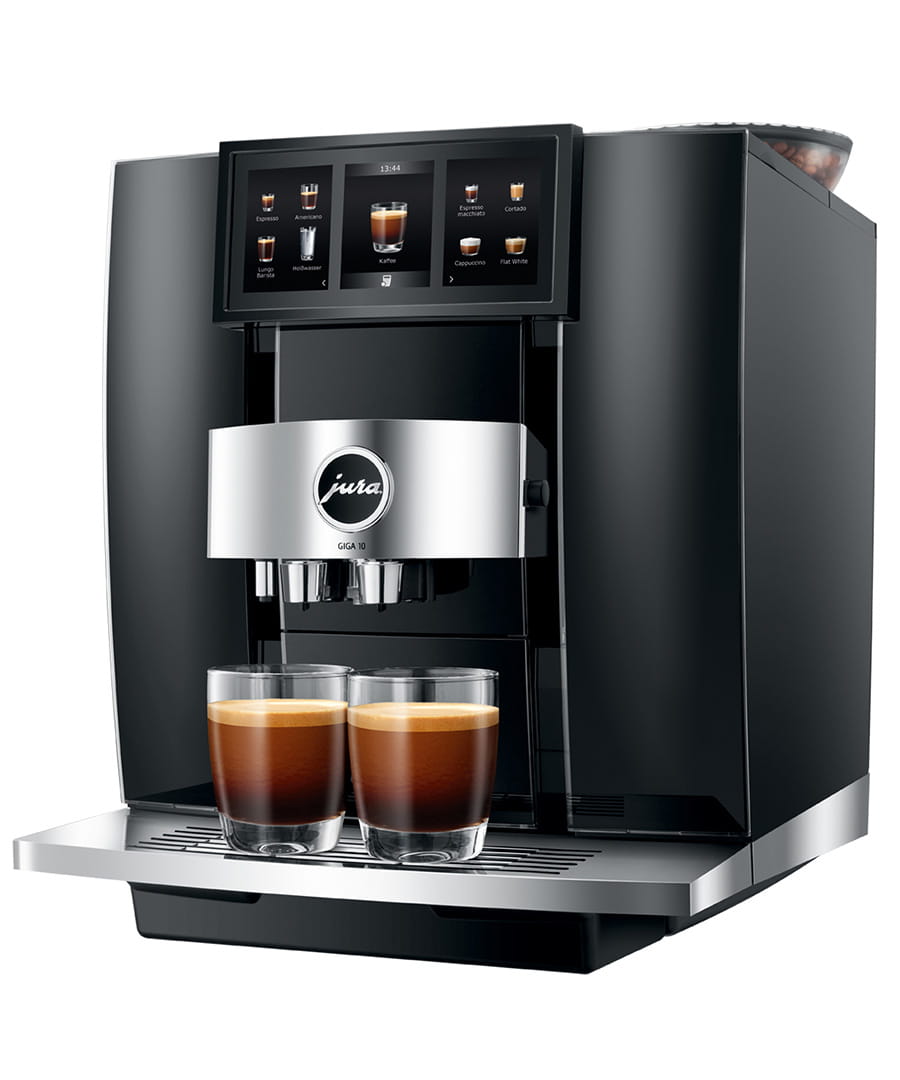
Put a Jura GIGA 10 next to a Franke A300 and they look like cousins: two bean hoppers up top, two grinders inside, a touchscreen, a spout. The spec sheets even rhyme. But these machines come from two different worlds, and the differences that matter have almost nothing to do with the drinks menu. One is a household flagship you can have on your counter this week. The other is foodservice equipment - plumbed into your water line, certified for commercial hygiene codes, priced by quote, and installed by a dealer who expects to service it for years.
This comparison is really a category decision. Here is how to make it with actual numbers.
The Retail Ceiling
Jura GIGA 10 - The Most Machine You Can Buy Today
Dual grinders, dual heating systems, 35 one-touch hot and cold specialties. No quote, no installer, no contract.
Quick Answer
Under roughly 100 drinks a day, the GIGA 10 wins on price, drink range, and zero procurement friction - you can order it today for roughly half of what an installed A300 setup runs. Above that volume, or wherever plumbed water, NSF-conforming equipment, or a service contract is required, the A300 class is not just better - it is the only correct answer. The sizing framework below shows where the line actually falls for your numbers.
Two Different Product Categories, Not Two Competing Models
Our analysis starts with what each manufacturer actually built, because the marketing photos hide it.
The Jura GIGA 10 is the top of Jura’s household line. It makes espresso-based drinks: it grinds, extracts under pressure through a brew group, and runs milk through its Fine Foam system, all one-touch, with a cold-extraction mode for cold brew specialties. It draws water from a 2.6 L removable tank, plugs into any outlet, and is sold at retail - Amazon, Best Buy, authorized Jura dealers - at a knowable price.
The Franke A300 is the smallest machine made by Franke Coffee Systems, the Swiss foodservice equipment arm whose bigger machines run hotel breakfast bars and convenience-store coffee counters. The US-market version, the A300 Fresh Brew, is a different kind of machine than most people expect: it brews fresh-ground hot and iced coffee - not espresso - plus programmed tea water and hot water, from two 1.2 lb locking-style hoppers with dedicated ceramic-disc grinders. It runs on a standard 120V outlet, connects to a plumbed water line with a drain (or an optional internal reservoir), conforms to NSF STD 4 for commercial food equipment, and cleans and descales itself automatically because Franke assumes no staff member owns it.
One nuance that matters for anyone researching this matchup: the espresso-capable A300 variants you will see in international coverage - the FM EC with Franke’s FoamMaster milk foam and a refrigerated milk unit - are listed by Franke’s own product leaflet as currently unavailable in North America. In the US, “Franke A300” effectively means the Fresh Brew. So the honest US comparison is: one-touch espresso and milk specialties from a tank-fed home flagship, versus high-duty brewed coffee from a plumbed commercial unit.
Neither is the “better machine.” They answer different questions.
Spec and Capability Comparison
Everything below comes from the manufacturers’ own spec sheets and product pages, with sources listed at the end of this article.
| Spec | Jura GIGA 10 | Franke A300 Fresh Brew (US) |
|---|---|---|
| Category | Household super-automatic (espresso-based) | Commercial fresh-brew coffee machine |
| Drinks | 35 one-touch specialties, hot and cold, incl. espresso, cappuccino, latte, cold brew styles | Hot and iced brewed coffee, two bean types, tea water, hot water; no espresso drinks |
| Milk | Integrated one-touch milk system (Fine Foam) | None built in; milk and foam modules sold as add-ons |
| Water | 2.6 L (87.9 oz) removable tank | Plumbed line + drain, or internal reservoir option |
| Beans | 2 x 280 g hoppers, dual grinders | 2 x 1.2 lb (~2 x 544 g) hoppers, dual ceramic-disc grinders |
| Rated volume | No official rating; our estimate ~100 drinks/day ceiling | Up to 80 cups/day, every day (manufacturer rating) |
| Certifications | Sold and marketed as a home appliance | Conforms to NSF STD 4, UL 197 (ETL listed) |
| Size | 12.6”W x 16.1”H x 19.3”D, ~40 lbs | 13.4”W x 21.5”H x 23.1”D, ~55 lbs |
| Power | Standard outlet | Standard 120V outlet (1.2-1.5 kW) |
| Price (approx.) | ~$4,000-$5,500 retail, moves with promotions | No published list price; dealer quote (one US listing: ~$8,880) |
| How you buy it | Check Price → | Dealer contact form, quote, install |
A note on the capacity row, because it is the most important and least symmetrical one. Franke’s “up to 80 cups per day” is a manufacturer duty rating: the A300 Fresh Brew is engineered to do that volume every working day for years, which is what NSF-class commercial equipment means. Jura publishes no cups-per-day rating for the GIGA 10 at all. Our ~100 drinks/day ceiling is our own planning estimate, reasoned from the dual-boiler hardware and tank capacity, and it describes what the machine can absorb - not what Jura warrants it to do daily. A machine that can do 100 on launch day and a machine rated to do 80 every day for five years are not the same claim, and pretending otherwise is how offices end up buying the wrong class of equipment.
The Sizing Framework: Where a Tank Tops Out and a Water Line Takes Over
Daily drink count is the whole ballgame here, so let us make the refill and intervention burden concrete. We use the same assumptions as our office bean-to-cup guide: roughly 6 oz (about 177 ml) of water drawn per drink including automatic rinses, about 10 g of beans per drink, and one intervention = one water refill, one hopper top-up, or one grounds empty.
For the GIGA 10, a 2.6 L tank holds about 14 drinks’ worth of water, the two 280 g hoppers together hold about 56 drinks’ worth of beans, and the grounds container takes about 20 pucks. For the A300 Fresh Brew in its plumbed configuration, water interventions are simply zero - the line feeds it and the drain empties it - and the two 1.2 lb hoppers together hold roughly 100 drinks’ worth of beans. Franke does not publish the grounds container capacity, and the plumbed configuration supports a grounds chute cut through the counter into a bin below, which can remove even that task.
| Daily volume | Jura GIGA 10 (tank-fed) | Franke A300 Fresh Brew (plumbed) |
|---|---|---|
| 30 cups/day | ~5 interventions/day (2 water, 1 beans, 2 grounds) - comfortable | ~1/day or fewer (0 water; beans every ~3 days; grounds as needed) |
| 60 cups/day | ~8 interventions/day (4 water, 1 beans, 3 grounds) - workable, needs an owner | ~1-2/day (0 water; beans every ~1-2 days; grounds as needed) |
| 100 cups/day | ~14 interventions/day (7 water, 2 beans, 5 grounds) - someone touches it every 30-40 min | ~2-3/day, but over its 80/day rating (step up to Franke’s A400/A600 class instead) |
Our assumptions, stated in full: figures are planning estimates built on the manufacturer capacities above, not measurements. Real numbers shift with drink mix - long coffees draw more water, and the GIGA 10’s milk drinks add milk-container handling we have not counted. The A300 grounds cadence cannot be computed because Franke does not publish that container’s capacity.
Read the table bottom-up and the story tells itself. At 30 cups a day, the GIGA 10’s five daily touches are a non-issue in any office with a kitchen rota, and you saved thousands of dollars. At 60, the tank treadmill is real but survivable if one person owns it. At 100, a tank-fed machine needs attention every half hour of the working day - and that is precisely the volume where the A300’s plumbing turns “coffee machine management” back into “coffee.” The crossover zone is roughly 60 to 80 cups per day: below it the GIGA 10 is rational, above it the plumbed commercial class is, and inside it the deciding factors are the procurement and service questions below, not the hardware.
Under ~100 Cups a Day?
The GIGA 10 Is the Rational Buy
Run your own numbers in our office guide’s demand worksheet, then check what the GIGA 10 costs today.
Procurement: Shopping Cart vs Sales Cycle
The purchase experience may be the biggest practical difference between these machines, and nobody’s spec sheet mentions it.
Buying a GIGA 10 is buying an appliance. You check the price, you click, it arrives in a box, you fill the tank and plug it in. Total elapsed time from decision to first cappuccino: a few days. If it breaks, Jura’s US support model runs through authorized repair centers - typically a ship-in repair with a flat-rate flavor, which is tolerable at home and mildly painful for an office that loses its machine for a week or two.
Buying an A300 is procurement. Franke’s US site lists no prices - the path is a contact form, a conversation with a dealer or office coffee service (OCS) provider, a quote shaped by configuration (plumbed or reservoir, milk or foam module, telemetry), an install visit that may involve a plumber, and almost always a service agreement. That single retail listing we found at about $8,880 is best read as a floor for the hardware alone. This is not a defect of the channel; it is the point of it. The dealer who quotes you is the dealer whose technician shows up on-site when the machine goes down, often under a response-time commitment, with parts on the truck. Offices running 80 cups a day through one machine are not buying coffee equipment, they are buying uptime - and the contract is what uptime actually costs.
There is a legitimate middle path worth naming: many OCS providers will lease machines of the A300 class per month, bundled with beans and service, converting the capital decision into an operating expense. No such market really exists for household Jura machines.
Where the Franke A300 Wins
Being honest about the competitor is the entire value of this page, so concretely:
- Rated, warranted volume. “Up to 80 cups per day” from the manufacturer beats any estimate anyone can offer about a home machine. If your demand is daily and sustained, a duty rating is worth paying for.
- Plumbed water and drain. Zero refills, zero drip-tray emptying in the plumbed configuration, and with the grounds chute option, near-zero daily touches. At real commercial volume this is not a convenience, it is the difference between a machine that serves the room and a machine the room serves.
- NSF STD 4 conformance. If the machine will serve the public - a lobby, a cafe corner, a self-serve counter - your local health code very likely requires NSF-listed foodservice equipment. The A300 Fresh Brew conforms; Jura’s home line is not marketed with any such listing. In these settings the comparison ends before it begins.
- A service network built for businesses. Dealer-installed, dealer-serviced, on-site, often with telemetry (Franke Digital Services) watching consumption and errors remotely. Nobody carries your GIGA 10 to a repair center under this model.
- Iced coffee and tea at volume. Programmed iced coffee and dedicated tea-water and hot-water buttons cover the full office beverage station brief, not just the coffee drinkers.
- Locking hoppers and access control. Small thing, until the office machine is in a semi-public hallway.
Where the Jura GIGA 10 Wins
- It makes espresso drinks - the A300 you can buy in the US does not. Cappuccino, flat white, cortado, cold brew specialties, one touch, integrated milk. The US-market A300 Fresh Brew brews coffee, and its milk options are add-on modules. If your office actually wants lattes, this line alone settles it.
- Roughly half the money, all-in. Around $4,000-$5,500 at retail versus a quoted install that starts near $8,880 before plumbing and contract. For a 10-person office, that gap buys years of beans.
- No procurement cycle. Ordered today, brewing this week. No quotes, no site survey, no plumber, no multi-year agreement to exit if the office moves or shrinks.
- Footprint and looks. Smaller in every dimension, 15 lbs lighter, and designed to be admired in a kitchen rather than tolerated in a break room. It needs an outlet and 2.6 L of water, not a water line and a drain.
- Drink personalization. 35 configurable specialties, bean blending across the two hoppers, and per-drink strength and temperature control. The A300’s menu is configured once, by whoever set it up, for consistency - which is what foodservice wants and enthusiasts do not.
- A clean exit. A household machine holds resale value and can follow you home. Commercial equipment with a service history and a dealer lien on your loyalty does not.
For a deeper look at the Jura side of this ledger, see our full GIGA 10 review and the GIGA 6 vs GIGA 10 comparison if the budget resists.
The Verdict: Let the Cups Decide
Count your realistic daily cups, honestly, including the growth you expect.
Under about 60 cups a day, the GIGA 10 is the better purchase for almost everyone: dramatically cheaper, vastly better drink range for US buyers, and available now. The intervention burden is real but small enough for a shared kitchen to absorb.
Between 60 and 80 cups, you are in the crossover zone. If someone will own the machine and the room wants espresso drinks, the GIGA 10 still works. If nobody owns it, if the machine faces the public, or if downtime is unacceptable, get the A300 quote.
Above 80-100 cups, or wherever a health inspector has opinions, stop shopping at retail entirely. That is commercial territory, and our companion piece on when Jura stops being commercial enough covers what lives above the GIGA line - Franke’s bigger A-series included - and how to buy it without getting quoted into the wrong tier. For how Jura compares against other brands generally, see our full competitor comparison guide.
The Retail-Class Answer
Jura GIGA 10 - Dual Grinders, Dual Boilers, Zero Procurement
If your numbers land under the commercial line, this is the most capable machine you can simply order: 35 hot and cold specialties, two bean hoppers, and no service contract attached.
Check GIGA 10 Price on Amazon →FAQ
Can you buy a Franke A300 on Amazon?
Not through Franke’s normal channel. Franke sells the A300 through its dealer and office coffee service network with quoted pricing - the official US site lists no prices anywhere. One US online retailer listed the A300 Fresh Brew at about $8,880 including shipping when we checked, but the typical path is a dealer quote covering configuration, installation, and a service agreement. The GIGA 10, by contrast, is a normal retail purchase.
Is the Jura GIGA 10 good enough for an office?
For most offices, yes. By our planning estimates it absorbs up to roughly 100 drinks a day in bursts, and it is the highest-capacity machine Jura sells at retail. The honest caveats: Jura publishes no daily duty rating, the 2.6 L tank means several refills a day at higher volumes, and it carries no NSF listing for public-facing service. Run your team’s numbers through the demand worksheet in our office machine guide before deciding.
Does the Franke A300 make espresso?
The version sold in the US - the A300 Fresh Brew - does not. It brews fresh-ground hot and iced coffee plus tea water and hot water. Franke’s espresso-capable A300 variants with the FoamMaster milk system exist internationally, but Franke’s own product leaflet lists the A300 and its milk cooling unit as currently unavailable in North America. For one-touch espresso and milk drinks at this scale in the US, the GIGA 10 is the machine that actually does it.
What does a Franke A300 actually cost?
There is no published US list price. Pricing arrives as a dealer quote shaped by configuration (plumbed or reservoir, milk or foam add-ons, telemetry), installation, and the service contract. The single US retail listing we found was about $8,880 for the machine alone. Many offices lease this class of machine monthly through an office coffee service instead of buying outright.
Does the A300 require a plumbed water line?
No. Franke offers it in a plumbed configuration with a drain, or with an integrated water reservoir and removable drip tray. But the plumbed setup is the point of the machine: it is what reduces daily interventions to almost nothing at commercial volume. If you plan to run the reservoir version at 60+ cups a day, you are reintroducing the very refill treadmill you were paying to escape.
All prices are approximate and change frequently - use the price buttons on this page for current figures. The GIGA 10 typically retails between roughly $4,000 and $5,500 depending on retailer and promotions. Intervention and cups-per-day figures for the GIGA 10 are our own planning estimates built on the manufacturer capacities above, using the same assumptions as our office guide (6 oz of water per drink including rinses, 10 g of beans per drink, one puck per drink); Jura publishes no cups-per-day rating and we have not load-tested either machine at commercial volume. Franke’s 80 cups/day figure is the manufacturer’s own published rating for the US Fresh Brew model. Specifications last checked: July 2026.
The Retail-Available Flagship
Jura GIGA 10
35 specialties, dual grinders, up to roughly 100 drinks a day. The A300 is dealer-quoted only - no direct purchase link exists.
As an Amazon Associate, we earn from qualifying purchases at no extra cost to you.